Showing posts with label UBI. Show all posts

Wednesday, November 3, 2021

Growing Together Again - Picking Winners and Losers threatens to Further Divide the Nation

 The View From Rattlesnake Ridge

Ruminations from an Unabashed Optimist, an Environmental Patriot and a Radical Centrist


Despite the Climate Emergency wreaking havoc throughout the nation and the world, and the Covid 19 pandemic still plaguing us, autumn here in the valleys between the Rattlesnake Ridge and the Sandwich Range has been just about picture-perfect this year. Welcome periods of warm sunny days, punctuated with mostly gentle soaking rains, beckoning to hikers and climbers and leg-stretchers like Kodi and I. Inviting us to partake of the autumn colors. 


It has also been a banner year for mushrooms and fungi. In fact, I have never in my life seen the forest floor covered by so many mushrooms. Even now as their presence is beginning to wane people are still commenting on the abundance and speculating on the reasons. 


Mushrooms are the gloriously emerging fruiting bodies of a fungus that is growing underground (mostly) from what are called mycelium, nerve-like tendrils that can spread for many miles without ever being seen. 


Now I know just enough about mushrooms to be dangerous, which is why I am very cautious about gathering them to consume. Most of the time I rely on my son Zach who is far more experienced at partaking of wild edible mushrooms. But there are certain mushrooms, like the Morel family, that are quite distinctive and even I can safely gather them for dinner. Problem is, they are usually pretty rare around these parts. But this year I have found them growing in an old abandoned apple orchard that Kodi and I enjoy often on our rambles. 


All these mushrooms aren’t new to the northeast or wherever they can be found; the mycelium has been here underground all along, just waiting for the ideal temperatures and rain we had this summer and fall. In theory they could go for hundreds of years without ever popping their fruiting bodies above ground.


The natural wonder of all this is a balm for the souls of the wanderers, but, to quote Tolkein, “not all those who wander are lost.” For the past 30 years scientists have turned increasingly to the hidden miracles of mycelium and what they have discovered - as well as what they continue to discover - is likely to hold an entire world of revolutionary changes to both our understanding of the natural world and our ability to rebuild our own species into a sustainable cohabitant of the planet.


Deep Roots Poster


When most of us walk through a forest or a park we see only the trees, shrubs, and plants above ground. We know from experience and education that these plants have root systems but what has only recently been discovered is that the entire ecosystem in which we are wandering communicates through the mycelial network below ground in what scientists have come to dub the “Wood-Wide-Web”; weaving in and out and through root systems and creating a biological neural network - sharing information, nutrients, water and carbon across distance, species and ecosystems.


A Fusion of Magic Mushrooms

Moreover, far broader implications are being discovered from the wonders of what is called the ​​mycorrhizal network. According to Scientific American: “​​mycelium can be coaxed to build predictable structures by controlling temperature, CO2, humidity and airflow to influence the growth of tissue. This is a rapid process: the accumulation of fibers becomes a visible speck after a few hours, a visible sheet after a day or two, and an 18-by-2-by-12-inch sheet weighing a couple of pounds within the course of a week.” All powered by simple and relatively inexpensive nutrients like wood waste or sugars. “ 


The possibilities are mind-bending. Mycelium's fast-growing fibers that produce materials used for packaging, clothing, food and construction - again according to SA “everything from leather to plant-based steak to scaffolding for growing organs. Mycelium, when harnessed as a technology, helps replace plastics that are rapidly accumulating in the environment.”


“All these benefits come with little environmental cost: the process of growing mycelium results in limited waste (mostly compostable) and requires minimal energy consumption.” Already bio-degradable packaging is being created in the US and Europe using this technology.


Now you may be wondering, if you read this column now and then, how I am going to turn this all into a discussion of current political and policy questions. 


Painted Fungus

Start with the fact that much of the research being done in this area is under the research umbrella of DARPA; The very same government entity that developed the World Wide Web is doing research - based on the “Wood-wide Web” that will unleash a new massive wave of economic and environmental benefits.  


Unfortunately, if the past is prologue, the billions of dollars of taxpayer money used for research to create this revolution will ultimately accrue to a few select companies and individuals who will capture and patent technologies based on the work of these government research institutes and affiliates. The economic benefits to average taxpayers will be crumbs by comparison. But it need not be that way. 


Shouldn’t the revolution created by this amazing research also lead to a revolution in the public policies by which we employ and enjoy the benefits - sharing the wealth with those who have paid for that research - the American people? 


Congress is currently deadlocked over a 3.5 trillion “human infrastructure” bill which has deteriorated into a food fight over numbers, with very little attention paid to what lies behind the spending. As much as the Democrats have tried to refocus the conversation to the content of the bill, they have been unable to so do. Those opposed, even the Republicans, refuse to specify what they would choose to remove, largely because they know if they pinpoint anything it will affect the outcome of their next election. Face it, people are hurting and 50 years of growing disparity of wealth in America has opened up a hole in the hearts of too many of our fellow Americans. In 2016 Donald Trump walked through that hole and quite nearly destroyed the Republic. 


Flying into a Gathering Storm

It isn’t just the Republicans who willingly and knowingly followed Donald Trump down that rabbit hole who are responsible.


The Democrats, including Joe Manchin and Krysten Sinema, bear some responsibility as well. But Manchin and Sinema are only nominally more responsible than many others who simply see the opportunity to feather the nests of their own pet issues. When faced with the opportunity to really do something different, many of the Democrats fell right back on their old playbook: Picking winners and losers and leaving the status quo essentially unchanged.  In the process, leaving a whole lot of our fellow citizens feeling abandoned in their desperation, and leaving that hole in their hearts equally vulnerable to a second Trump candidacy - or a Trump surrogate - in 2024.


If we really want to bring Americans together again, and it will not be easy,  we need to abandon the status quo; the additive process of increased spending based on winners and losers.  Our focus must be more on change that benefits everyone and - on the other side of the ledger - requires joint sacrifice to confront our most important challenges. 


Aspen Central

Doing this might just cause some of the moderate Republicans, hiding in the tall grass, to show the backbone needed to save their party from oblivion or their country from a descent into totalitarianism.


It might just be, in fact, it is highly likely, if we sincerely reformed the existing system, we could do more with less. A Universal Basic Income for every American citizen, supported by many conservative and progressive economists, would not favor community colleges over great small private or public colleges or quality certification programs in dozens of fields. Those who chose to spend some or all of their UBI on continuing education would be able to make their own personal choice. A UBI would not prioritize care of a dying parent over care of a newborn or vice versa; it would not prioritize dental care over other healthcare needs or personal needs. It would give every American the freedom to choose how their benefit would most effectively enhance their life and the life of their family. It would allow us to take a serious look at the massive social service bureaucracy that we have built over the years in the name of protecting citizens from themselves or punishing those we felt were less deserving for whatever reason. Unleashing real freedom of choice for low-income and working and middle-class Americans.


Exempt from Public Haunt

While a UBI would be the most effective and revolutionary change it would not be without it’s notable advocates. First proposed by Thomas Paine it was also supported by Richard Nixon who successfully shepherded it through the U.S.House only to have it killed in the Senate by Democrats and Nixon’s own personal failings. Supporting Nixon’s UBI back then was the conservative Economist Milton Freidman to whom Republicans, even today, continue to pledge fealty. 2020 Presidential candidate Andrew Yang is even now indicating that he expects to create a third political party with a UBI as a central tenet. If you think this represents an existential threat to the two-party system, you’re right. But if you think that Trump would be the beneficiary you have missed the reason he won to begin with altogether.  


While we are at it, it's high time we had national service in this country. One or two years of service in either the military or civilian corps would go a long way to bridging the differences that continue to manifest themselves in tribalism among our citizens. It need not be absolutely mandatory. For example we could create an opt-out similar to the conscious objector exception during the Vietnam era, or we could simply tie national service to qualification for the UBI. Interestingly, a good deal of research suggests that a “gap year” (or two) following High School would be dramatically beneficial to post-high school educational performance for most students.


Of course, not every priority requires the same treatment. The Climate Emergency initiatives - or at the very least equivalent effort built on other ideas - will benefit everyone and address our most urgent, existential crisis. The unity required of the effort is built into the nature of the challenge. 


A scientific revolution, brought on by breakthroughs like those chronicled above - perhaps equal to the birth of the Internet, has a power of its own and creates radical change defined by its possibilities, not by status quo politics and self-interested politicians; Limited only by our imagination and dedication to the premise outlined in our constitution: 


"To form a more perfect union, establish justice, insure domestic tranquility, provide for the common defence, promote the general welfare, and secure the blessings of liberty to ourselves and our posterity.”


Democracy is not a static state, nor is capitalism.  They are operating systems, requiring leadership that fearlessly embraces change to achieve its optimum outcome on an ongoing basis . . . that is how we achieve a more perfect union . . . and perhaps how we come together again.


Apples in a Jefferson Wind Row

Links

Scientific American
The Mycelium Revolution Is upon Us

https://blogs.scientificamerican.com/observations/the-mycelium-revolution-is-upon-us/


The National Forest Foundation

Underground Networking: The Amazing Connections Beneath Your Feet

https://www.nationalforests.org/blog/underground-mycorrhizal-network


About Wayne D. King: Wayne King is an author, artist, activist and recovering politician. A three-term State Senator, 1994 Democratic nominee for Governor; he is  the former publisher of Heart of New Hampshire Magazine and CEO of MOP Environmental Solutions Inc., and now a columnist for the New Hampshire Center for Public Interest Journalism (inDepthNH.org) where he writes “The View from Rattlesnake Ridge” and hosts two Podcasts: The Radical Centrist (www.theradicalcentrist.us) and NH Secrets, Legends and Lore (www.nhsecrets.blogspot.com). His art (www.waynedking.com) is exhibited nationally in galleries and he has published four books of his images and a novel "Sacred Trust"  a vicarious, high voltage adventure to stop a private powerline - all available on Amazon.com. His art website is: www.waynedking.com , and his writing site:  http://bit.ly/WayneDKing . He lives in Thornton, New Hampshire at the base of Welch Mountain where he proudly flies both the American and Iroquois Flags.






Sunday, August 1, 2021

Toward A Fairer Distribution of Wealth


Toward A Fairer Distribution of Wealth
After 50 Years of Backsliding, the Opportunity for Americans to Share the Wealth of our Economy Lies within Reach.

Some days as I ramble the fields and hills of the White Mountains I find myself pondering all the mistakes we have made as a nation in what we have always hoped would be the path to a “more perfect union”. It can be a most discouraging exercise. Slavery, genocide, religious intolerance and exclusion, all of these tragedies, and more, have made the path to the Founder’s dreams of a land where talent, ambition and ideas allow any citizen to rise - to succeed - more daunting.

Let’s face it, we can never truly make up for the wrongs that have been done monetarily.

Two thirds or more of the landmass of the United States alone was in the “possession” of Native American people for millennia before and during the 200 years following Columbus’ wrong turn. That’s a lot of real estate.

We can never fully atone for the grievous wrongs against African Americans perpetrated by Slave Traders and internecine kidnapping by warring tribes and factions on the African continent or the years of slavery that followed as well as the Jim Crow era, and the overt and institutional racism that has characterized the years since.

The mistreatment of generations of immigrants, the Irish of course, but particularly those from outside of Northern Europe, set back their advancement within the American Dreamscape by decades, if not centuries.

The treatment of Japanese Americans during the second world war and the confiscation of much of their existing wealth as well as ongoing racism that impacts those of asian descent.

The marginalization of women since the beginning of it all.

All of these and more original - and ongoing sins - of the Republic amount to far more money than we could possibly account for - no less tax for or pay out.

Add to all this the - now fifty year - downward spiral of incomes of the majority of Americans and you have a problem so daunting that no one quite believes we can truly address it.

But we can begin and, at least as a start, we could do so relatively painlessly with some real and sustainable benefits to all our citizens.

First the why…

1973. That is the year that many economists and historians point to as the turning point of the (modern) wealth disparity in this nation. In 1900 the gilded age of robber barons, was beginning to pass. Reforms by Republican Teddy Roosevelt’s administration began to reverse an earlier wealth disparity. The Progressive era brought more reforms driven by a golden age of journalism that helped expose the dark underbelly of the previous wealth disparity brought on largely by the Railroad interests, the oil and timber interests and other industrial age monopolies that had dominated the economic landscape of the country in the latter half of the 19th century.

With the obvious exception of the Great Depression, much of the 20th century - and especially the mid-century - was a time when the great middle class began to flourish. Even the wages and wealth of the sub-middle classes (sometimes referred to today as the “Precariat”) saw gains.

But in 1973 those gains hit a wall.

It was the first year when American wages declined in what would become a long pattern of decline; fifty years long as of today.

Until that time many of the reforms of the New Deal including tax policy and changes in the law to encourage the growth of labor unions had kept wages for the middle class, the working class and poor on an upward trajectory. In other words, their percentage of the wealth generated in the country was growing.

1973 was also the beginning of another phenomenon that is rarely noticed or mentioned by economists and historians and certainly not by politicians at any place on the political spectrum . . . a declining personal and economic freedom among these very same people.

As declining wealth and growing disparity began their slow rending of the American fabric, efforts were made to plug the holes in the dike of American prosperity. Put simplistically, these efforts were intended to deal with social and economic problems created by the growing disparity of wealth. These problems were widely acknowledged. Eisenhower, a moderate by today’s standards, acknowledged that the welfare system was “necessary to reconcile the masses with the capitalist system.” But there were wildly different interpretations of the solutions that created an uncomfortable alliance between those who would prefer to ignore the problems, or, worse, punish those who were lower income Americans, and those who saw their role as “protecting” them. That alliance came in the form of more and more onerous restrictions on those who received any form of “welfare” transfer payments. This made the “protectors” complicit in the denial of freedoms, particularly economic freedoms. It was during these years that America saw the construction of the welfare bureaucracy.

There were - in fact - plenty of transfer payments to the wealthy and the upper middle class that were not accompanied by such punitive action - for example the mortgage tax deduction and the deductibility of real estate taxes from the Federal income tax. Capital gains are taxed at a lower rate than income derived from work, a completely absurd notion. But few politicians batted an eye when it came to those transfers of wealth.

Later critics would, cynically, refer to this as the “welfare state” or, more derogatorily, the “nanny state” where every low income family found themselves being micromanaged by both the right and the left. The irony of course is that these same critics were equally complicit in creating this state.

So for fifty years not only have incomes diminished as well as the share of wealth within the overall economy, but personal and economic freedoms have diminished as well. A single mother might take a second job but often she would run headlong into a provision in the law that required another payment to be decreased because of her added income, creating not only an economic disincentive to improve her economic standing but effectively diminishing that standing. Ironically, this “welfare” system not only treated those among the Precariate classes as second class citizens with respect to their personal and economic freedoms, it also became a bureaucratic monster consuming vast amounts of wealth to “police” the punitive restrictions on the economic gains of lower income Americans.

Efforts made to try and correct the inequities were subject to a “wrinkle in the rug” reality in this new welfare system. Addressing one wrinkle would simply create a new one that popped up in response to the onerous penalties assessed on the Precariat classes for the mere act of attempting to improve their economic condition.

The sad fact was, and remains, that those earning the most were encouraged and rewarded for seeking ways to enhance their prosperity while those earning the least were punished and disincentivized for doing the very same thing. Over time the gap has widened and today even the vaunted middle class is shrinking, sliding inexorably into the precariat at its lower margins.

Aside from the obvious moral and ethical reasons we should be concerned about this there is a very practical, political reason that lies at the heart of our current political woes. The strength and stability of a democratic political system - we have learned over time - is tied to the strength and vibrancy of its middle class. When Americans (or any people) are invested in their future - when they see their place in that future and feel that they can count on the system to give them a fair shake - they will support, defend, and sustain it. When they begin to doubt that system all bets are off.

Additionally, from an economic point of view, the real engine of economic growth was being choked off. Despite the dogma of the right that businesses create jobs and wealth, the fact is that people, and specifically consumers, create jobs and wealth. As middle class and precariate consumers see their income dwindle they are able to spend less of their wealth on anything except necessities.

For 50 years now we have seen the glue holding us together slowly dissolve. To the ranks of the already-marginalized we have added untold millions of Americans of every color, creed, religion. From coal miners to pensioners who have seen their retirement disappear in a blue haze of bankruptcies, mergers and acquisitions; from homeowners caught up in Wall Street’s sub-prime mortgage fiasco to families bankrupted by crippling healthcare costs; each with a different story, each subject to their own unique sadness and vulnerable to the swirling miasma of finger-pointing, retribution, blame, and conspiracy theories. Caught up in the same general whirlpool we have divided into a tribal morass, each with its own boogiemen and culprits further dividing us at the very moment when we should be coming together.

I have to admit to being totally caught off-guard by the QAnon conspiracy theories. After all, they are so nutty as to completely strain credulity but they are a sure measure of how far we have fallen. Only the Salem witch trials provide some historical context but even now we realize how insane they were.

The How

Over the course of our history Americans have paid taxes that have created and maintained our roads, bridges, air and seaports. We have funded the cost of education - producing a ready made workforce. We have funded research that has produced untold innovations and staggering wealth. The US Department of Defense spends more annually on R&D than any other entity on the planet.

Every time you open your smartphone you see examples of the fruits of that research. Many of those applications represent companies that have turned that government-funded research into billions of dollars of private wealth, all thanks to the research efforts funded by EVERY AMERICAN.

In effect making the American people the large investors in their success. Yet when the dividends are paid out John and Jane Q Public are not among the shareholders receiving a check.

Instead we watch as politicians play divide and conquer over meager tax revenues. Will we fund paid family leave or tax credits? Will we fund affordable day care or tuition assistance? Will we fund . . . The list goes on and on. Many of these programs are terrific ideas that would certainly serve to improve the quality of life for American citizens but often they benefit only a segment of the population. A system for allowing Americans to share in the wealth of an expanding economy while having the freedom to decide how their piece of the pie was used would make far more sense, especially if, at the same time, we were able to deconstruct the welfare bureaucracy and add those funds to offset its costs.

Call it what you want: A Freedom Dividend, a Sovereign Wealth Fund, an American Dividend. A mechanism for sharing the wealth of our economic growth is within our reach. It is not a lack of wealth that holds us back, it is a lack of will and imagination. Furthermore, it is an ideal that has currency across the political spectrum. Richard Nixon, for all his many faults, proposed just such a system during his presidency, conservative economists like Milton Friedman supported the idea. Many of America’s billionaires, recognizing the value of the R&D investments that undergird their company’s success, and fully cognizant of the dangers of the growing disparity of wealth, have expressed support and a willingness to see both taxes and research proceeds used to help fund such a system.

A Painless and Progressive Start

It is unlikely that this shift to some kind of Universal Basic Income could happen quickly. Developing the political will and the public support will take time and a concerted effort to educate the American people - helping them to understand that such a change would not represent a handout but the natural evolution of capitalism to reward every citizen for the economic growth in the American economy derived from the investments made by each of them.

Now is the ideal time to begin that process for several compelling reasons.

A serious body of research is now available and developing rapidly to determine how such a dividend might be calculated and paid for. This includes some ground-breaking research on using blockchain technology that might allow a UBI provided completely outside of any government bureaucracy.

Several current legislative initiatives present a way to test-drive both the idea of dividends as well as linking benefits of the economy from research and development to the distribution of wealth in our society.

The Carbon Fee and Dividend Act, (now the Energy Innovation and Carbon Dividend Act of 2021 HR 2307) initially proposed by Republican statesmen James Baker and George Schultz, and now supported by a broad coalition of Republican and Democratic legislators as well as environmental, and business leaders and their organizations and companies with the Citizen’s Climate Lobby leading the effort. HR 2307 holds the promise of lowering carbon levels and putting the revenues generated by the fees imposed directly into the pockets of all citizens. While this measure only addresses revenues from a fee on carbon it would provide a working model of such a dividend to the American people and at the same time help us to bring our economy into a net-zero carbon future by 2050.

President Biden has proposed more than 350 billion dollars in new research and development in the rescue and infrastructure packages. These research projects are sure to generate huge economic spinoffs. Biden should appoint a special commission to study potential spinoffs and ways in which those spinoffs might be shared with the American people who are - in fact - funding them. Research and development are essential components of sustaining a growing economy. If the United States is to maintain its economic dominance, and present a viable alternative to the efforts of China to dominate the world’s economic infrastructure. What better way could there be to build public support for ongoing investments in R&D and Infrastructure than to make the American people shareholders in the wealth that they generate?

Finally, there is a growing call for reigning in America’s “Tech Sector” from all points along the political spectrum. Recognizing that mechanisms for making every American citizen an “investor” in these tech sector businesses opens up a whole new set of possibilities for new ideas that allow us to address the issues that concern Americans while adding some nuance into the process. In other words, it adds a series of options that permit the problems to be addressed with a scalpel instead of the traditional all-or-nothing approaches that we have taken in the past. When the question facing us is more than simply “do we break up Google or Facebook or Amazon?” or whatever new mega-company emerges in the future; but, rather, how do we make changes that invest our citizens in the future of our economic growth and encourage entrepreneurial opportunities in a dynamic and competitive economy? The options for innovative ideas are endless, as are the opportunities for finding common ground between people of widely different viewpoints.

We could use a bit of common ground these days.


Links:


Welfare Programs Promote Bureaucracy Rather Than Self-Sufficiency
Damon Dunn: Pacific Research Institute.
https://www.pacificresearch.org/welfare-programs-promote-bureaucracy-rather-than-self-sufficiency


Thursday, May 14, 2020

Roaring Back Economically - Now is the Time for a Basic Income and National Healthcare

American Spirit

The View From Rattlesnake Ridge
Ruminations from an Unabashed Optimist, an Environmental Patriot and a Radical Centrist


Roaring Back Economically
Now is the Time for a Basic Income and National Healthcare


In this age of Covid-19, I am unable to experience the day to day joys of sharing time with neighbors and measuring their sentiments, hearing their stories, and drawing on them for life lessons. There will come a time, again, when we will be able to do this, and again I will return to my perambulations among neighbors in search of their stories and sensibilities for this column.

For now, my walks and rambles are solitary. I am alone with only my thoughts, the sounds of the brook, the wind, the pileated woodpeckers hammering at the trees, the red squirrels chattering at me. Some days my thoughts are small and parochial. Some days they range like a mountain lion, covering ground like a river tracing its tributaries high into the rocky precipices.

Lately, most of those thoughts have focused on the tragedy confronting our beloved American family. Today, my mind wandered to my other family, a proud part of the American family but also distinctive in its own way.

My Grandfather’s people, and by birthright mine, the Haudenausanee - also known as the Iroquois - in the early years of the republic would range well down into the Rattlesnake Ridge area from time to time, sometimes in search of game and other times empire. For 500 years before the birth of the United States, the Iroquois people nurtured and sustained the first and only democratic republican form of government. Long before the birth of Jefferson and Adams, even before John Locke from whom Adams and Jefferson drew inspiration, the Iroquois were gathering to make decisions collectively and democratically. There is evidence that Ben Franklin looked to the Iroquois confederacy as he helped craft the US Constitution.

Esheheman's Breath


One of the most striking aspects of the Iroquois Confederacy’s democratic deliberations is that they were required to consider the effect of their actions, not just in terms of their immediate needs, but in light of the effect on the next 7 generations before arriving at a decision. So today I am doing just that in my rambling ruminations.

This pandemic has laid bare many of the weaknesses in our democracy and our economy. A significant portion of the economic tragedy has its roots in an economy that for 50 years - since the early 1970s - has slowly drained wealth from the middle class, the working class and the poor. Only a year ago a report from the Federal Reserve found that 40% of Americans would be unable to cover a $400 emergency with cash, savings, or a credit card. This growing disparity of wealth had already begun to blossom into a crisis before we were struck with the Covid-19 crisis affecting every aspect of American lives.

The existential crisis of Climate Change has faded from the light of public discourse, eclipsed by an even more immediate crisis. But, like the Covid-19 Pandemic, Climate Change is a science-based crisis and if there is one thing that we have all learned - with the possible exception of the Trump administration - science-based challenges don’t respond to lies, bullying, and spin. Eventually, they will bite you.

The marginalization of communities of color has come into full public view as the numbers of cases and deaths among black, brown, and Indian communities dramatically outpace even the high numbers among the general population.

These and other challenges are mixed in the rich stew of partisanship and culture wars, cooked up by Newt Gingrich in 1994 and today boiling vigorously as Donald Trump turns up the heat in anticipation of the coming election. One need only count the number of times the President uses the words “I” and “me” when he addresses the nation or the media, and how little he uses the word “we”. His lack of empathy for the 80,000 plus Americans who have lost their lives is shocking and disheartening, but not surprising.


The good news is that American’s have come together as we always do in a real crisis. There are signs that the efforts of a small vocal minority supported by the President are causing even that rare unity to fray but polling shows that most people have taken their lives and their safety into their own (well-washed) hands and have stopped listening to the President and turned their attention to those who will tell them the truth.

Even Congress has demonstrated a willingness to push partisanship aside in the best interests of the American people. Let’s hope they continue to do so because the challenges ahead are going to require that they continue to step up and that the sacred cows of both the Republicans and the Democrats will be put to the test and found wanting.

This Pandemic raging around us has created the perfect storm for many Americans - a catastrophic convergence of forces over which we have almost no control.

Since the beginning of this pandemic, it is estimated that 27 million Americans have already lost their health care insurance and that number may rise to 45 million before the worst is over. Despite this, the Trump administration refuses to reopen enrollment in the ACA, otherwise referred to as “Obama Care”. Congress should immediately reopen the ACA enrollment. Furthermore, they should do something they have stopped doing for a long time - taking a page from the Iroquois Confederacy and looking for solutions that consider the next 7 generations of Americans. Americans deserve a national healthcare plan that covers every single American.

Over the course of the last few years I have made the case for an American Dividend, more commonly referred to as a Universal Basic Income based on the presumption that Americans have contributed to the wealth of the nation through their sacrifices, their labor, and their taxes - but have never been included as shareholders in the economic miracle. I won’t reiterate all of the arguments for a UBI here, but you can read previous columns about it and there are a lot of people of all political persuasions who are now talking about it and writing about it. What I will do is try - in a few paragraphs - to make the case for doing it NOW - even as a temporary measure - as the most effective way to drive our economy forward and find our way out of this pandemic while respecting and protecting one another.

As impatience grows for restarting our economy and for resuming some semblance of normalcy in our day-to-day lives we will continue to experience the push and pull between economic needs and health and safety needs. While we must let the science and data drive our decisions in order to minimize the rate of new infections and deaths, we clearly must begin making efforts where possible to reopen the economy and return to life in a new normal. However, the challenge we face is one at the confluence of science, psychology, and economics, presenting a significant challenge and the need for our leaders, and each of us, to exercise judgment. Even as our Governors and policymakers begin this process, carefully laying out rules regarding testing, tracing and isolation, social distancing, and other safety measures, many folks will not be comfortable resuming “normal” life without confidence that we have flattened the curve sufficiently to make venturing out safe. Furthermore, rebounding economically, especially for our small businesses, will be profoundly challenging at 25% or even 50% of their previous capacity. We need to find a way to harness the economic power of both those who are ready to venture out and those who are not. Here’s where a basic income for every American can drive a robust resurgence.

Amazon founder and CEO Jeff Bezos makes $6.54 billion dollars per month. If he dines at the most expensive restaurant in America, “Per Se” Restaurant in New York City, it will cost him $685.00. In his home state of Washington, “the Herbfarm Restaurant”, located on the outskirts of Seattle will cost you a more affordable $285. But Jeff Bezos can only eat ONE dinner.

One month of Jeff Bezos income would cover a $2,000 basic income for three million two hundred seventy thousand Americans, roughly 1% of the entire population; men, women and children; roughly 2% of American households.

So here’s a simple question: What is going to have a greater impact on the US economy: a month of dinners for Jeff Bezos (at $8,550) or 10 million dinners purchased by American families from local grocery stores and restaurants? Which of these is more likely to help save small businesses on Main street?

Now I’m not picking on Jeff Bezos, whom I admire immensely, but last year any one single American paid more in taxes than Amazon, which paid no taxes because of a tax code heavily skewed to the wealthy in our nation.

Businesses don’t create jobs, CONSUMERS create jobs through demand and businesses respond by hiring labor sufficient to meet the demand. It’s simple economics.

Put a basic income of $2,000 per month in the pockets of every American for the remainder of the year and it will cost half of what any of the previous 3 “relief” packages have cost and you can bet that - whether they are sheltering in place or out and about - Americans will drive the economy and support their local businesses. With real disposable income, the free market will determine how that income is used and most of the businesses we know and love in our communities all over America will find a way through this crisis. Furthermore, you will see a flurry of new entrepreneurial activity as Americans find new ways to create jobs and generate income using some of that disposable income to launch startups. In addition to this the President, The Speaker of the House, and the Majority Leader of the Senate, should appoint a blue-ribbon task force to look at ways to fund a basic income permanently.

None of this should be construed to ignore the need for an aggressive, nationally-directed system of testing, tracing, and isolating. If we had a national service requirement, that most Americans - from all parts of the political spectrum - support, we would be able to activate that network of millions of Americans to do the testing and contact tracing. As it stands the use of Americorp and Peace Corps volunteers could be activated immediately to fill much of the need. If we do not aggressively develop such a system quickly, few of us will feel comfortable about emerging into a world where a simple, and desperately needed, embrace can end in tragedy.

Americans of all political persuasions have set aside their differences in this pandemic and we can hear the faint but growing sound of the American song rising from their efforts, as they cheer for our frontline heroes, as they check on elderly neighbors and greet one another walking in the park or on the trail, even in acts as simple as paying for the coffee of the next car in line at the Dunkin Donuts drive-through.

Keep singing. Don’t let tribalism and partisanship derail what could be the great American renaissance after we beat back Covid-19. Dream 7 generations ahead.


Wayne King is an author, artist, activist and recovering politician. A three-term State Senator, he was the 1994 Democratic nominee for Governor and most recently the CEO of MOP Environmental Solutions Inc., a public company in the environmental cleanup space. His art is exhibited nationally in galleries and he has published three books of his images with another, "New Hampshire - a Love Story", on the way. His most recent novel "Sacred Trust" a vicarious, high voltage adventure to stop a private powerline is available on Amazon.com. He lives in Thornton, between Rattlesnake Ridge and the Waterville Range. He proudly flies both the American and Iroquois Flags. His website is: http://bit.ly/WayneDKing
UBI, Basic Income, American Dividend, Roaring back, recovery, Pandemic, Covid-19, truth, testing, healthcare, insurance, national service

Thursday, April 9, 2020

Quiet, A Partisan Truce, A Reset, and, Perhaps, a Renewal


Hope in Our Time


The View from Rattlesnake Ridge
Quiet, A Partisan Truce, A Reset, and, Perhaps, a Renewal

Social Distancing is relatively easy here in the shadow of Rattlesnake Ridge and along Orris Road at the base of Welch Mountain in Thornton, where I’ve recently moved. One only has to step out the door and head in any direction to find deserted trails and fresh air aplenty. It’s quiet and peaceful. Yet, like everyone else, I feel the cloud of our national crisis looming over me as I walk. I worry about my nephew Jeremy Maggin, in the thick of the battle as an ER Doc in Los Angeles, along with his wife, Stephanie, a nurse at Kaiser Permanente, administering tests to suspected COVID 19 victims. My niece Hallie Jennings is a nurse right here in New Hampshire and I worry about whether she has proper PPE to protect her and the elderly patients for whom she cares. We are so proud of them and so fearful for their futures.

Walking along Orris road for the first time since last fall, I feel a little like the old “Peanuts” character Pig-Pen, the dusty cloud of worry and caution tagging along just behind me.

But despite it all: despite the heartache for all the Americans who are suffering right now; despite the concern for friends and family and the unknown millions of others who are facing the financial and health challenges brought on by the virus; despite my silly sadness that my favorite old “wolf-tree” has fallen during the course of the long winter; I am also - like so many Americans - looking for hope and for ways that I can be of use to my fellow citizens. I am seeking hope and purpose in the wake of this international crisis.

The President, unsurprisingly, has been not only irrelevant but downright counter-productive. Am I sad and angry about that? Hell yes. But let’s set him aside for the moment. There’s plenty of folks providing far more thorough critiques than I could in this column. Further to that, the calm, empathic and steady leadership of Governors Cuomo, Baker, Newsome, Sununu and others provides a far more powerful countervailing force than anything else and I am thankful every day that they are providing that leadership. The time will come when we litigate the past few months but let us not be blinded to the hopeful signs that have arisen in the midst of the pandemonium because they contain the seeds of an American renewal - perhaps even a broader one.

Federalism, the system of government that divides power between the National and State governments has, ironically, been both the bane of our battle against the virus and our saving grace. The Federalist system, designed by those who gathered in Philadelphia in that smoldering hot summer of 1787 has provided the backstop for a Federal system crippled by 20 years of growing and bitter partisanship added to 50 years of growing income disparity. When push came to shove, America’s governors, mayors and civic leaders have - for the most part - stepped into the breach created. Equally important, in the face of the pandemic Americans have chosen science and reason over the hollow rhetoric of a small number of wingnuts on both ends of the political spectrum. If you watch and listen, you can once again hear them singing the American song.

Governors - especially Governor Cuomo who finds himself at the center of the crisis - Mayors, the media, Republicans, Democrats, and Independents, stepped forward to fill the leadership vacuum with common sense, courage and tenacity and, most importantly, honesty. Healthcare workers, EMT’s and paramedics, nursing home workers, truckers, police and firefighters, corrections officers, and the US Military, including the National Guard, even grocery clerks, have all rushed in despite the dangers. Countless state and national workers, most of whom we will never even know have been propping up the system, are also going to work every day despite the dangers. These are the folks so cynically labeled as the “deep state” by those who don’t understand that they are the heroes who make government work for us. They too are stepping up in this time of crisis. Even the Congress set aside differences to stand together in our hour of need.


Aspen on the Roaring Fork River


In short, while the administration has failed us, Americans have come together and they are getting the job done. It’s not pretty . . . but it is truly beautiful.

Americans have come together in an unprecedented fashion and while it may seem premature to look to the day when the smoke will have cleared, for me it seems the most useful thing I can offer that will honor the magnificent heroism of those who have the talent and heart to wade into the medical crisis while so many of us do our - admittedly modest - civic duty by staying at home.

The Coronavirus crisis has laid bare many of the weaknesses that have developed in our society over my lifetime.

Healthcare
For my entire life, we have stood by as advanced countries all over the world created healthcare systems that served ALL of their people while ours left millions behind, even though we have spent more per capita than any of the other nations. We should not emerge from this crisis without a national system that provides healthcare to every American.


Income Inequality
1973, the year I graduated from High School, was the last year that middle-income wages and those of the poor and working-class grew, beyond the cost of living. Yet during all those years the taxes of those same Americans continued to educate generations of children, build and maintain roads and bridges and airports and railroads that guarantee a vibrant, mobile and innovative workforce for the 1% who have seen their wealth increase a thousandfold. 

Our smartphones are crowded with apps created largely through the sweat and generosity of the American people - who through their taxes have financed the research of an alphabet of agencies from DoD, to USDA to NASA, DARPA, and ARPA where research drove the development of the Internet and the Apps that have created cost-free avenues to wealth for many.

If you are a regular reader of this column you have already read many of my arguments for Universal Basic Income. Principally based on the belief that UBI (or whatever you choose to call it) should represent a fundamental recognition that Americans at every income level have, for years, invested in the American economy but we have yet to recognize a means of rewarding average folks for the equity value that is rightfully theirs. There are also a host of other social challenges that can benefit from a universal recognition of the investments of every American in the capitalist economic system ranging from reparations “due” nearly every social group to freeing the poor and working-class (commonly referred to now as the “precariot”) from the “welfare pimps” of the left and the “welfare demonizers” of the right, and the challenge of providing quality, well-paying jobs in the new “gig economy.

New research being done into linking UBI to block-chain technology offers very promising ways of fairly determining what portion of the equity value within the economy should be allocated to various sectors of the economy - INCLUDING INDIVIDUAL AMERICANS, as well as how to assure that resources to fund a UBI are available and fairly assessed and preventing anyone, or any group, from gaming the system. Bear in mind that the lions share of the cost of a UBI can be funded by simply reallocating funds already being spent to provide our social safety net, used far more efficiently because we will be able to squeeze most of the bureaucratic costs out of such a system. We may even be able to take a shot at other challenges like college and trade school tuition, child care, paid family leave and a host of other expensive ideas - converted from “entitlement to al-la-carte personal priorities.”

There is no better time than now to begin. The Corona Virus has already compelled us to institute what is a temporary form of UBI to assure that Americans can survive the economic hit of this crisis. A Universal Basic Income would provide stability to the economy as we emerge from the Corona crisis and unleash a wave of entrepreneurial activity that truly would create an economic renaissance. UBI is not a liberal or a conservative idea - after all it was most recently proposed by President Richard Nixon and conservative economist Milton Friedman but it is also supported by liberal economists like former Labor Secretary Robert Reich and Libertarian thinker and economist Charles Murray.


Esheheman's Breath


Climate Change
While we are on the subject of saving capitalism and the planet. There is no better time to adopt the Carbon Fee and Dividend idea first proposed by conservatives George Schultz and James Baker. With the cost of gasoline at historic lows, this bi-partisan idea will allow us to leverage the existing marketplace cost of carbon-based fuels and the lull in atmospheric carbon dioxide production. The existential crisis of climate change has witnessed a temporary reprieve. With millions of cars taken off the roads, we have been given a rare opportunity to look to the future and take action now, while the opportunity still exists. The fee and dividend concept presents a market-driven means for assessing fees in a low-bureaucracy manner and further boosting the monthly income of middle class and working-class Americans by putting a carbon dividend in their pocket on a monthly basis.


Renewing the American Spirit through National Service
While our young men still register for The Selective Service, even with an all-volunteer military, women are not expected to do so. The Peace Corps is a shell of its former glory and AmeriCorps - as great as it is - remains an enigma to most Americans. We have lost the national pride and the unity of purpose engendered through the expectation that all should serve the country in some capacity. Universal Service for every young person in America provides a pathway to moving beyond the poisonous partisanship that has infected our country.

Restoring a Vibrant Democracy
We are already seeing the cracks in our democratic system created by trying to preserve democratic institutions in the age of the Corona Virus, especially our national franchise - the vote - as difficult as it is to find consensus in this era of partisanship, we must find ways of assuring that no American is disenfranchised and every American can easily register to vote and cast their vote in elections.

Pandemics are never happy but in the very brief history of humans on this planet, the one constant seems to be that they have opened the doors for social changes that served the greater good. The Black Death was also the death knell for serfdom and the beginning of the enlightenment and the birth of a middle class. The 1918 Flu Pandemic ushered in the social safety net of Social Security, Medicare, and women’s suffrage.

To achieve these things we will need to take full advantage of the spirit alive in America right now. The notion that we are all in this together and the belief that we can emerge from this hell a stronger, better and wiser people. We can begin by making every possible effort to end the marginalization of people and the demonization of those who do not share our social and economic circumstances.

There is no shame in being wealthy and there is none in being poor. But there is shame in acting as though that wealth is ever actually self-made, just as there is shame in believing that someone else owes you a living and that self-improvement and self-sacrifice is for other folks, not me.

To Jeremy, Stephanie, Hallie, and the millions of Americans on the front lines today, if I am here when the smoke clears I pledge to you that I will fight every day to assure that this tragedy yields to an American renewal that will make you proud to have fought the fight to save us all. I believe that most of us will do you that honor.


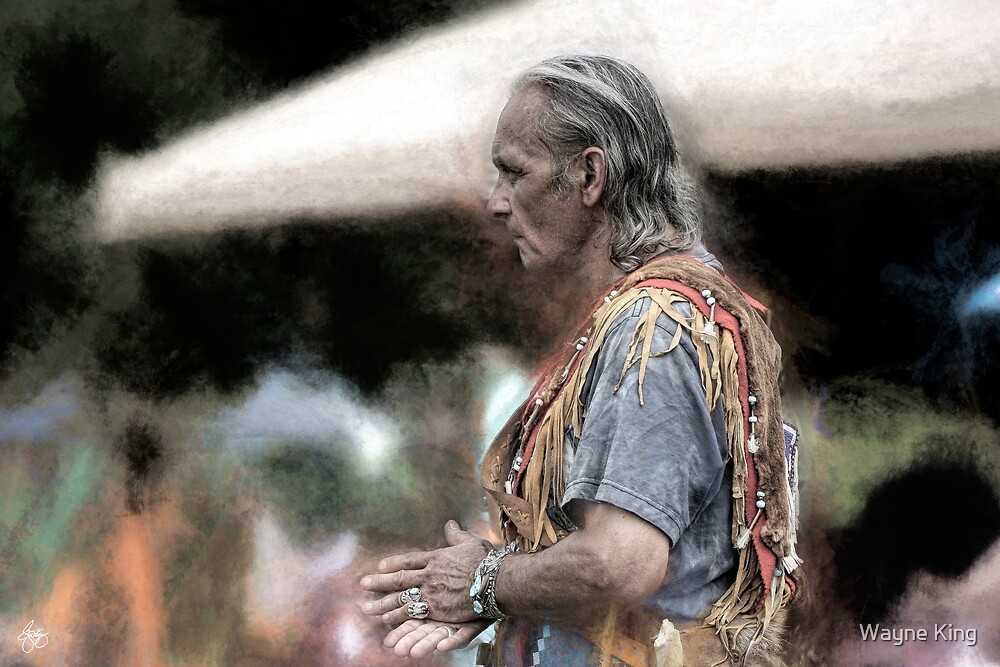
Dance of a Woodland Elder


About Wayne D. King: Wayne King is an author, artist, activist and recovering politician. A three-term State Senator, 1994 Democratic nominee for Governor, now a registered Independent; he is also the former publisher of Heart of New Hampshire Magazine and CEO of MOP Environmental Solutions Inc., and now the host of two Podcasts - The Radical Centrist (www.theradicalcentrist.us) and NH Secrets, Legends and Lore (www.nhsecrets.blogspot.com). His art (www.waynedking.com) is exhibited nationally in galleries and he has published three books of his images and a novel "Sacred Trust" a vicarious, high voltage adventure to stop a private powerline all available on Amazon.com. He now lives in Thornton, New Hampshire at the base of Welch Mountain where he proudly flies both the American and Iroquois Flags. His website is: http://bit.ly/WayneDKing . You can help spread the word by following and supporting him at www.Patreon.com/TheRadicalCentrist .

Monday, April 30, 2018

The Future of Work: The Gig Economy is Here to Stay.


The Gig economy is the term on the tip of the tongues of commentators and analysts these days. It’s a very broad term that describes both the increasing tendency of employers to hire independent contractors and short term workers rather than add new full time employees, and their accompanying taxes and benefits, to their workforce. It also describes a range of individuals who, by choice or necessity, build an income around work that is self-directed and without both the benefits and the downsides of a traditional job. A gig job may be a sole source of  income or performed in addition to a traditional job that doesn’t generate the income necessary to either the needs or the financial aspirations of the person involved.

The Gig Economy may seem to be a new phenomenon to many, but to folks who live in the shadow of Rattlesnake Ridge it’s been a way of life for a long time. When my friend Micky Lewis, whom you’ve met in this column before, delivers wood to my home in the middle of the winter, between snow plowing gigs, he’s supplementing work as a contractor that comes and goes with the vagaries of the economy and the real estate market among other variables. Now this is the life that Micky has chosen, but for many such work comes as a necessity. The trade off that many of us made to live here is that well paying jobs tend to be less available here.

So now the phenomenon has spread throughout the economy and we have a name for it, possibly named from the well known phrase “I’ve got a side gig doing . . .you finish the sentence”.  

The Gig Economy is not well defined. In fact, to date, no formal definition has been established even for the terms “Gig Economy” or “Gig Worker”. Furthermore, statistical information that really measures the number of people engaged in the gig economy is nowhere near the level of sophistication as those who are employed in the full time labor market. The Bureau of Labor Statistics has stubbornly clung to measuring three things: “Farm employment, non-farm employment and employers, there just aren’t that many gradations for job categories beyond that except by industry” according to the most comprehensive research on gig jobs I have found at Nation1099.com (see below).  

There are some understandable reasons for this. After all we are trying to measure not only those who make their entire living putting together gigs, both online and offline, as well as the people who have a job but supplement it with gig jobs; and those who label themselves consultants. In an effort to attempt to get a handle on this part of our economy the GAO issued a report in 2014 and could not decide whether the portion of workers that BLS defined as “Contingent Workers” represented 5% or 40% of the workforce.  It is estimated that as much as 90% of the jobs added since 2015, encompassing all three of these, have been gig jobs. 47% of Millenials, who make up the largest portion of the workforce, according to surveys are engaged in some level of freelance work.

A few other instructive bits of data are worth considering:

  1. According to Forbes Magazine, since 2000, 1099s have gone up 22%, while the traditional W-2 forms have stagnated.
  2. Some researchers project that half of the working U.S. population will move into the gig economy within the next five years.


Among the trends nationally that will have the greatest impact on the number of people in the Gig economy is the alignment of small business growth and Gig Economy growth. These days when most people think of the Gig Economy they think of big companies like Uber, Lyft, AirBNB, etc. but one of the fastest growing area of Gig Job growth is new and expanding small businesses who find it easier and more affordable to hire freelance workers than to add individuals to their payroll. This is partly due to costs but it is also caused by a new trend in business with jobs being broken down into component parts with the work divided between technological solutions (robots, software, etc.) and freelance workers for specific tasks that cannot yet be solved employing technological solutions.   

All of the trend lines indicate that the Gig Economy is here to stay. It will bring massive change, massive opportunity and massive disruption to the economy and our lives, making it both exciting and dangerous, particularly when combined with another trend in business, exchanging technology for labor. Most economists, futurists and other prognosticators predict that by 2020 almost half of the entire labor force in the US will be employed within the Gig Economy. That’s the same year, by the way that many say we will begin to see massive disruption in the largest source of individual employment, drivers as driverless trucks and automobiles begin the process of what very well may become a driverless society by 2050.

Now, the good news and the bad news. First, most people who are employed in some way in the gig economy indicate a high degree of satisfaction. Varying polls show a satisfaction rate of as much as 75%. They enjoy the flexibility and the freedom that it provides for them.

The bad news is that almost all of the people employed in the Gig Economy are within the middle class strata of society. Very few of the working class and poor, whom I have referred to as the Precariat, are currently engaged in this sector of the economy. Where there is massive income disparity between the wealthy and everyone else already, this threatens to make the problem even worse.

Furthermore most jobs within the Gig Economy have no benefits and therefore fall outside of the social safety net that we have constructed since the Great Depression.

Meanwhile, Trump Tweets, the Republicans hide and the Democrats are gleefully looking to 2018 without a clue of what they will do - other than to hold impeachment hearings -  if they take over the control of the House and/or the Senate. Granted, the Democrats have no power within the government but they could be setting an example by telling us what they would do if they did. It may be that their relationship with labor - which in fairness was largely responsible for building the middle class in this country - has paralyzed them. Labor has already been through a dramatic decline in America and they are fighting to maintain their clout. The Gig economy represents an existential crisis for them.  Unless the labor movement comes up with some new approaches to organizing, their days are numbered.

Here’s the problem in a nutshell, while we have moved to Workforce 2.0 in the global economy our governance is still stuck in Democracy 1.0 and Capitalism 1.0 and that is a real and growing problem. If I were advising an insurgent Republican candidate or an Independent Candidate for President I’d tell him or her to adopt a radical centrist agenda that spoke to the greatest threats to American economic stability and democracy. Go BIG or Go Home as they say.  It would take a whole lot of guts and it would be a high risk strategy. It might also be the first real step toward righting the ship of state and saving both capitalism and democracy.


Links:
http://nation1099.com/gig-economy-data-freelancer-study
http://www.forbes.com/sites/gregoryferenstein/2015/12/12/the-gig-economy-appears-to-be-growing-heres-why/
https://smallbiztrends.com/2016/07/20-surprising-stats-freelance-economy.html


About Wayne D. King: Wayne King is an author, artist, activist and recovering politician. A three term State Senator, he was the 1994 Democratic nominee for Governor and most recently the CEO of MOP Environmental Solutions Inc., a public company in the environmental cleanup space.  His art is exhibited nationally in galleries and he has published three books of his images. His most recent novel "Sacred Trust" a vicarious, high voltage adventure to stop a private powerline, has been published on Amazon.com http://bit.ly/STPaper. He lives in Rumney at the base of Rattlesnake Ridge and proudly flies both the American and Iroquois Flags. His website is: http://bit.ly/WayneDKing

From "Screen Door" to "String Too Short to Keep"

  From "Screen Door" to "String Too Short to Keep"  A poetic journey across time and space in New Hampshire with Poet El...