Showing posts with label moderate. Show all posts

Friday, March 23, 2018

Finding the Center - Reversing The Hollowing of the Political Center in America

Back in the 80s when he coined his famous phrase, it was fine for Jim Hightower to declare that there “Ain’t nothing in the middle of the road but yellow lines and dead armadillos” when it was a satirical jab at moderate politicians in the midst of robust debate across the political spectrum, but the hollowing of the political center in America now threatens to collapse the system on itself like a political black hole.


Of course it is true that the margins define where the middle lies and for at least the last two decades there has been a gradual movement of the political center to the right. This is not, in and of itself, unusual. Shifting fortunes of political parties have a long tradition on the American political landscape, often - but not always - for good reason. The problem was that the Republican party was not satisfied with simply gaining ground. Instead they smelled an advantage and decided that moving the goalpost itself was to be their end game. They began first by violating two of the most sacred norms of American politics during the last one hundred years.


In their groundbreaking book “How Democracies Die” authors Steven Levitsky and Daniel Ziblatt deconstruct the modern day process by which Democracies descend into totalitarianism; not by military takeover, violence or assassination but rather by the election of politicians who allow or collude to create a gradual erosion of what they call the “soft guardrails of democracy”  These are the institutional norms that reflect our shared American Voice . . . the spirit of our system and the laws that govern us. Levitsky and Ziblatt label these norms “Mutual Toleration” and “Institutional Forbearance”. Mutual Toleration is the norm, or belief, that our political adversaries are NOT our enemies, that they love their country just as deeply and, while they may see the world differently, we accept their legitimacy and their right to govern if they prevail within a fair and democratic process. Institutional Forbearance, its twin norm in a successful and strong democracy, is the political restraint to live within both the letter and the spirit of the law and to avoid overreaching that strains the bonds of our common beliefs.


A strong and successful democracy has a broad range of voices that make their case strongly and loudly, even joyously, but respects the people and their right to decide within the marketplace of ideas, who will represent them.  Just as important those in power, exercise restraint and do not abuse the system to seek unfair advantage, through processes that are technically legal but outside of the spirit of the law. When the governing party uses tactics like partisan gerrymandering that gives them an excessive advantage; voter suppression in the guise of “election reform” that makes it harder for certain groups of Americans to vote; or hold up the appointment of a Supreme Court Justice as the Republican Senate and leader Mitch McConnell did with Judge Merrick Garland. These things begin to create an atmosphere of hostility that can spiral out of control; An environment where not only is one party violating the spirit of the law but the opposition party is tempted to abandon these norms themselves. The result, if the opposition succumbs to this inclination, is extreme polarization.


Over the last twenty years both the Republican Party and the Democrats have abandoned these norms. Republicans struck first in 1994 when they abandoned all pretense of mutual respect and used the language of hate to drive their “Contract with America”. Democrats struck back during the tenure of Barack Obama with the albeit less extreme use of Presidential Executive Orders. The result has been polarization unlike anything that any of us have seen in our lifetimes.  This polarization has been exacerbated by the balkanization of the media landscape with the rapid growth of conservative talk radio and Fox TV and a similar, though again not as dramatic, shift among some of the other media, like MSNBC, on the other side.


The polarization of the parties and the balkanization of the media has spread like a contagion through the country taking advantage of the growing desperation of a large number of Americans, many of them white working class, who see their real income shrinking.


Ironically, immigrants and people of color, who have and continue to unjustly bear the blame, were experiencing the same thing. The major difference being that they were already marginalized within the economy. For hard working white folks, this was something new and alarming.


This is where Levitsky and Ziblatt missed the most important reason for the perilous divisions in our country right now. The alarming and growing wealth inequality gap in our country. Wages and net worth of the bottom 90% of Americans have been stagnant since 1973. That’s right, 44 years of effectively losing ground. Today the richest 1% of Americans controls more of the wealth in America than they have in 50 years. 40% of the wealth of the country is in the hands of just 1% of our population. 76 percent of wealth is vested in the top 10% of Americans.


If middle class wages and those of the precariat* had been rising during that time, even just keeping pace with the cost of living, then politicians would not have been able to stoke resentment of immigrants and people of color because, after all, they were just chasing the American dream like everyone else, right?  But as the wealth gap has grown so too has the fear and resentment of the “other” and with Republicans ignoring them in favor of the wealthy and Democrats playing identity politics to try and stay even, working class Americans of all colors have paid the price.  


Seeds of hatred and division that fall on fallow ground whither and die, but sow those seeds on fertile ground and they take root and grow. Over the past twenty years or more the ground has grown more and more fertile. As income disparity has grown more and more of our fellow Americans have found themselves having to work harder and longer just to stay afloat, many are finding it impossible. Technology, has hit them like an Abrams Tank. If the shell of shrinking wages doesn’t find its mark, the twin treads of job obsolescence and artificial intelligence surely will. Exacerbating this is the decline of American social capital, disconnecting us from community and from one another, particularly limiting our exposure to people who are different from us for any reason. This is a phenomenon described as “Bowling Alone” by social theorist Robert Putnam.


In fairness to the authors quoted so extensively above, perhaps they chose to ignore the role of wealth inequality in creating the crisis we face because the roots of this problem go so deep and are so seemingly intractable that they wanted to focus on the things we could do more immediately to stem the bleeding in our Republic. I understand this but I also believe that it is the deepest taproot of this tree and if the tree of Liberty and prosperity is to flourish again in America, we will have to confront it - and soon. Not in another twenty years when it may be too late.  


Nevertheless, since I will be addressing this issue much more in future columns, I will stand down from my soapbox and try to address some shorter term solutions to the challenge of halting the “Hollowing of the American Middle” and restoring the center again.


The deep polarization within our political system has spawned at least one other notable phenomenon worth mentioning. Not content to have gained serious ground by ignoring ``critical norms that have guided us for more than 100 years the Republicans did something that all those sinking into the sands of tyranny do, they turned on those in their own ranks whose loyalty was questionable. They turned on their own centrists - those “disloyal” Congressmen and Senators who had the unmitigated gall to believe that members of the other party were not monsters but the loyal opposition - sweeping most of them from office through the noun they have verbified as “primarying”. There is nothing wrong with having a broad range of thinkers in the political process, in fact it is healthy, but like two shores divided by a great river flowing into the future there must be a bridge that joins the two sides. This has been the most important role of centrists in politics. They have been the bridge that sees good ideas where ever they come from, working to bring the two sides together for the good of all.


If we do not restore the center in American politics we will surely witness what may be the unraveling of the American Republic, caught up in an endless cycle, lurching from left to right until one party or the other decides to put country ahead of political gain or we self destruct.


So what, then, do we do? (while we are working on that thorny income gap problem!)  


First, we sing out in the American Voice. Each of us must hold those running for any office accountable. We must ask tough questions, and we must expect that they will have answers to how we might heal our country again. The specific answers are less important than the clear indication that each has given serious thought to the matter.   


if the elections this fall are in fact the blow out for Democrats that is being forecast, the Democrats need to understand that this will not be a mandate for them. It will be because the “Coalition of the Decent” - as described by Republican operative Steve Schmidt - has risen up to wrest the country from the clutches of despotism. The Democrat’s challenge, as painful as it may be, will be to show the country what it looks like when adults are running the government . . . to model mutual tolerance and exercise forbearance. As Nelson Mandela put it “to surprise our adversaries”.  If they can do this, despite the challenges, they will capture enough of that coalition to be successful in the future.


As sympathetic as I am to those who say that Democrats should fight like Republicans, that will only make the problem worse and probably assure that the pendulum will swing back in next election . . . and you know what that means.


In the longer term, we will have to take other steps to restore the center. Here are some of the things I would suggest:


End Partisan Gerrymandering:
Since the day when Massachusetts Governor Elbridge Gerry’s last name was annexed to the “salamander” descriptor given to one of the districts redrawn to benefit his political party back in 1812, It has been a common practice for political parties who find themselves in power during the term following a census to redraw the election map in their favor. Where Gerrymandering that disadvantages racial groups has been declared unconstitutional by the United States Supreme Court, “Partisan Gerrymandering” has - until recently - been accepted as a part of the spoils of political victory. This has now come under fire for good reasons. Throughout the country a fairly dramatic disconnect has developed between the political choices of voters and the outcome of elections. Partixan Gerrymandering, it is said, has created a situation where voters do not choose their representatives in elections but rather Representatives choose their voters when district lines are drawn.
The case of Wisconsin, now before the US Supreme Court, is particularly telling. In 2012 Democrats racked up 174,000 more votes for the state legislature - called “The Assembly” - than Republicans. Yet Republicans ended up with 61% of the seats in the Assembly . . . with only 49% of the votes, Democrats with 51% of the votes won less than 40% of the seats in the Assembly. Both parties should be incensed by this because the current system is just as likely to provide Democrats with the opportunity to stack the deck as Republicans and they are, sadly, just as willing to take advantage.


By any measure, this is wrong and it would be if the parties were reversed.  If you believe in the principle of one person one vote, this system defies that principle and effectively creates a rigged election. If the Supreme Court finds for the Plaintiffs in the case it could have dramatic effects on the electoral landscape but the last time that the Supreme Court considered this matter, in 2003, they punted. We should not wait for the Supreme Court. Efforts already undertaken by states like California and Arizona, arguably the most liberal and conservative states in the Union, have demonstrated that independent and balanced commissions can dramatically reduce the level of partisanship in their elected bodies. In addition to these commissions, several other innovative methodologies have been developed both here and in other nations that can and should be considered.  


Moving to Ranked Vote Balloting:
How often have you cast a vote when you felt that, aside from your choice of candidate, there were others who would do a perfectly respectable job? Ranked Voting, sometimes also referred to as Instant Runoff Voting, is a system of voting where the ballot allows the voter to rank the candidates in order of preference. If no candidate receives a majority of the vote then second and third choices are considered, using a system for allocating those votes until one candidate or another achieves a majority. There are also systems employed in other countries that are specifically created to address both the voting and the Gerrymandering problems together.


With Ranked Voting candidates can no longer count only on their “base” for an election victory - often at substantially less than a majority - but instead must be concerned about those voters who might see them as a second choice. Forcing them to be more specific about their positions on issues and tamping down the inclination to use negative campaigning as a political tactic.  


The Ranked Vote system of balloting gives the voter the opportunity to not only vote for the candidate of their choosing but also to cast an additional vote for one or more of their choices in their order of preference. Both voters and candidates in places where Ranked Voting is being employed say that it give moderates, and even Independents, a fair shot at the nomination or the seat and it reduces negative campaigning, with candidates concerned that negative attacks on their opponents will affect their weighted total of votes.


An unintended but consequential result of such a system would also be that it will make meddling in our elections much more difficult for the Russians or any other nation intent on doing harm to the American Republic, even that 400 pound fat guy sitting on his bed.
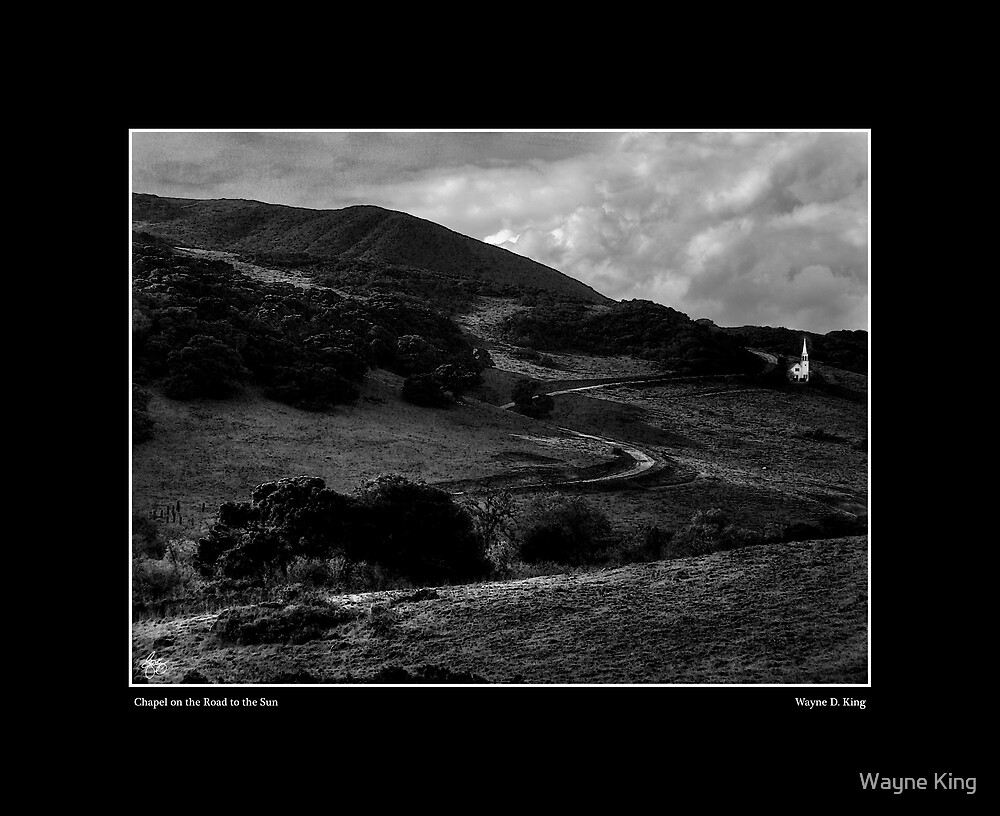
Chapel on a Road to the Sun Monochrome Poster


Money in Politics:


The deleterious effect of the “Citizens United” decision by the Supreme Court has been well documented. While I don’t foresee a change of heart among the members of the court at any time soon, we should continue to push for reforms that limit the effects of big money on the outcomes of political races. The suggestions above will have a significant effect in this area but money in politics is an insidious force, akin to rainwater on a leaky roof. If one avenue to enter the house is repaired the water will seek out other paths.


After thoughts:


Finally, though I might lose you on one or both of these, we might also consider a few other things. Encouraging the Senate - by whatever means - to bring back the old style filibuster instead of the nonsense that now passes for a filibuster. If all those Senators with their failing prostates had to actually stand up and debate for hours on end to hold up a bill I’ll wager we’d have very few filibusters.


A serious and substantive discussion about lowering the voting age to 16 instead of 18 is also in order. Ten other countries now permit it.  In Scotland the Parliament passed the franchise to vote for 16 and 17 year-olds unanimously after successfully testing the premise during their referendum on independence.


In the last few months our kids have taught us a lot about what it means to be a good citizen. Maybe it’s time to say that if they can teach us to be good citizens, they can vote as well. We allow 16 year olds to get married - they should be able to vote. They can’t do any worse than we have, and I suspect they would do a whole lot better. . . and by the way, any party that thinks they could count on their votes is in for a rude awakening - these kids are not going to be partisan. They scoff at the notion that any political party has a monopoly on good ideas or moral authority. If they get the franchise, you best sharpen your rhetorical skills.


You may have noticed that I have not once in this column mentioned Donald Trump. I have said it before. . . Donald Trump is not the cause of the crisis in our Republic, he is a symptom. As Pogo said in the now oft-cited quote from Walt Kelly’s famous comic strip, “We have met the enemy, and he is us.”


*Working class and poor - advancing quickly into the middle class


About Wayne D. King: Wayne King is an author, artist, activist and recovering politician. He was a three term State Senator,  who Chaired the Senate Economic Development Committee and the NH Senate Economic Summit. In 1994 King was the Democratic nominee for Governor and most recently the CEO of MOP Environmental Solutions Inc., a public company in the environmental cleanup space.  His art is exhibited nationally in galleries and he has published three books of his images. His most recent novel "Sacred Trust" a vicarious, high voltage adventure to stop a private powerline has been published on Amazon.com as an ebook (http://bit.ly/STrust ) or in paper at http://bit.ly/STPaper . He lives in Rumney at the base of Rattlesnake Ridge. His website is: http://bit.ly/WayneDKing

Monday, January 1, 2018

When Merit Guides Governance The 1992 NH Senate was One to Remember . . . and Emulate


The Shadows We Cast
Haiku and Image

The third major snowstorm of the winter hit us hard in the shadow of Rattlesnake Ridge, dropping more than a foot of new snow Christmas day on top of several feet that had already fallen in December.

No one was happier about that than my neighbor Alan Hunter who over the years has built a network of ski trails around the base of Stinson Mountain where he, and a group of his friends, ski almost every day in the winter . . . No one, except maybe Kevin Maas.

Where he lives in Dorchester, Kevin bought himself an old rope tow from a fellow who had it sitting in his barn for decades since a local ski area had gone defunct. Kevin is a fellow who just can’t resist a challenge, mechanical. He was the first person in the region to take an old diesel car and convert it to run on veggie oil that he gathered from local pizza parlors and Chinese restaurants. When he taught our son Zach how to do the veggie car conversion, he was kind enough to give him a few restaurants for the needed supply of “grease” and at 15 years old Zach converted a big old red Chevy Blazer he had purchased on Craigslist from a former Fire Chief on Long Island. Other than the
grease slick in our basement and myriad plastic jugs scattered around the woods by bears who found Zach’s near-empty jugs too yummy to resist, the experience was on the whole, most satisfactory.

Kevin is also a wakeboarder. During the summer he and a group of his friends, including Micky Lewis – our plow guy – Zach when he’s home, and other friends go wakeboarding on Stinson Lake until late summer.


This year though Kevin fixed up a water heating system that took advantage of the fact that the engine in his boat cycles water through the engine to cool it. He added a line that the intrepid wake boarders would put down the front of their wetsuits and heat up the layer of water between their bodies and the wetsuit. This let Kevin and his group of merry men and women wakeboard well into November; whereupon he gave up the lake and turned his attention to the rope tow. He began readying it for winter including cutting some glades in his woods to allow snow boarders and skiers to make their way down the hill behind his house after ascending it via rope tow powered by an old engine he had taken from a car that no longer required its service.

By now you are probably starting to wonder how I’m going to make this column transition into politics but fear not, there’s a method to my madness. You see, we radical centrists are drawn to those who get things done . . . people who, in the face of ideologues and other extremists, persist.

There is a lot of talk lately about how 2018 is going to see a dramatic shift in the fortunes of both Republicans and Democrats . . . maybe so. But if that shift is nothing but to have one group of  ideologues replace another we will be no farther along on our new American journey than we are today and the divisions that plague our country will be just as stark. However, there is a third way and the model for it can be found in our own New Hampshire Senate, albeit some  25 years ago. It affords an example for every legislature that is closely divided or where people of good will in both parties are willing to challenge the established dogmas to create meritocracies where what you know is more important than who you know . . . where allegiance is to country and state, not to political party.

In 1992 the NH Senate elections left the body divided 13 to 11 with the Republicans holding a slight advantage. In the typical spoils system that has afflicted us all too often, this would usually have resulted in the election of a Senate President and the Senate leadership from the majority party. Likewise all committee chairs would also be of the majority party, no matter how little they knew of
 their assigned committee’s responsibilities.


Just after the election then State Senator Jeanne Shaheen and I, two Democrats, along with Concord’s beloved Senator Susan McLane and Ralph Hough of Lebanon, two Republicans, met quietly in Madbury to craft a bold plan: To create a Senate where party took a second seat to merit and where Democrats and Republicans worked together for the good of the state.

I honestly don’t remember who contacted whom with the idea and it doesn’t matter. Senator Hough had a reputation as a moderate to progressive Republican whose political hero was Teddy Roosevelt, Susan McLane was a progressive Republican, undeterred by the slings and arrows from the far right within her own party. Both represented the great historic tradition of pragmatic Republicans in the mold of Warren Rudman, Perkins Bass, Sherman Adams and Charlie Bass.

Senator Hough we surmised would not have won an election among Republican partisans, but if the 11 Democrats held together, along with at least 2 Republicans he could win. Ultimately, that is just what happened; but on that day in Madbury we asked ourselves the more fundamental questions. How would we create a legislative body where people worked together; where Chairs and Vice Chairs were chosen for their expertise and their leadership ability; where fairness, transparency and achievement were the rule and not the exception?

At first we toyed with the idea of dividing everything equally between Republicans and Democrats, but that just seemed to be the same old wine in a different bottle. We decided that parity would be considered a value but not the be-all-and-end-all. We obviously needed to have a Senate President as a presiding officer but what required us to have vice presidents, or other titles that established some kind of formal or informal pecking order within the Senate? So in our brainstorming –  and later after Senator Hough had won, we did away with all these titles.


Since the goal was to create an atmosphere where Republicans and Democrats worked together for the common good developing consensus where possible and respecting differences where matters of personal  principle made consensus impossible, we considered completely eliminating the separate pre-session caucuses, an age old tradition that generally has been a partisan planning session. Senator Hough felt that he did not want to issue an edict preventing either party from gathering together when they felt it was important. Instead he announced that the entire Senate would be invited to lunch together before the session, in effect creating a bi-partisan caucus where we would have a final opportunity to develop consensus on contentious issues and if consensus were not possible to civilly alert one another that we were going to have a “floor fight.”


It was at these lunches that I developed a real and abiding respect for many of the Senators whom I had previously seen in a very adversarial way. Suddenly Senators, whom I had viewed only as adversaries, were no longer political enemies but colleagues with whom I often disagreed but who were human beings with whom I could break bread, talk, and, from time to time, compromise.


Senator Hough began the Senate term with a team building retreat for the entire Senate challenging us all to move beyond the constraints of party and to take risks for the good of our state. The retreat included not only Senators but staff members as well.
That year, as the country struggled to get its economy moving again the New Hampshire Senate – with a full sponsorship of both Republicans and Democrats passed five omnibus economic development bills creating an Office of International Trade; supported the creation of The Center
 for Earth, Oceans and Space at UNH, expanded the Port of New Hampshire, strengthened the Business Finance Authority, took the first steps toward development of a Community College system throughout NH among other things, all while balancing the State’s budget

By the end of the two-year term I considered many of my former adversaries among the finest, most principled people with whom I had ever served. They had not changed. The dynamic had.


In years past, legislators had opportunities to experience one another  as human beings, whether it was because they would gather together at the Highway Hotel for dinner or because they carpooled to legislative sessions. Today it is harder to find such opportunities but with some effort this small group of Senators upended years of partisan tradition to create what I believe was the most collegiate and
cooperative group of Senators that I had seen in all my 12 years in the NH House and Senate.


I will never forget what Ralph Hough said at the end of one of our early meetings. “They will probably throw us all out for this, but it will be worth the ride.”

I won’t represent that we changed the face of politics in New Hampshire – we didn’t. In the next election Republicans dominated the election and the Senate returned to business as usual, more partisan  than ever. It may have been the same if Democrats had dominated. But for one brief, shining moment, we glimpsed how things might be if change were built from the center out.

 I hope that Ralph Hough still thinks it was worth the ride. I know I do.
—
About Wayne D. King: Wayne King is an author, artist, activist and recovering politician. A three term State Senator, 1994 Democratic nominee for Governor, former publisher of Heart of New Hampshire Magazine and CEO of MOP Environmental Solutions Inc., and now host of two new Podcasts - The Radical Centrist (www.theradicalcentrist.us

) and NH Secrets, Legends and Lore (www.nhsecrets.blogspot.com). His art is exhibited nationally in galleries and he has published three books of his images and a novel "Sacred Trust"  a vicarious, high voltage adventure to stop a private powerline all available on Amazon.com. He lives in Rumney at the base of Rattlesnake Ridge. His website is: http://bit.ly/WayneDKing . You can help spread the word by following and supporting him at www.Patreon.com/TheRadicalCentrist .  

Monday, November 20, 2017

In Search of a Steady Hand and an Open Heart

The Golden Spire

Originally Published on . . . InDepthNH, Click here

A Steady Hand and Open Heart
Rebuilding the American Idea in a Post-Trump World

In the long shadow of Rattlesnake Ridge the talk these days at The Common Cafe or Plain Jane’s Diner in Rumney or Dot’s Bread and Butter Bistro in Ashland is often turning to who the next standard bearers in the political parties should be and what their message to the American people ought to be, with plenty of opinions on all sides about our President.

Normally these discussions would not occur for another year and a half but we are living in strange times. For most Americans, watching the President and the government that he is attempting to create is like watching a car crash in slow motion. We know that it’s coming. We just don’t know when the point of impact will be. More important, we don’t know whether it will be a fiery pileup or one car plowing into the Tree of Liberty and Decency; a tree that has been painfully and lovingly nurtured; nourished with the blood, sweat and tears of patriots, as it grew and expanded for more than 200 years.  

The recent elections in Virginia and New Jersey have some Democrats counting their chickens well before they have hatched. As Steve Schmidt, a former consultant to John McCain and an MSNBC Analyst said, the elections in these states represented a rising “Coalition of the Decent” from all political parties, one of the most astute observations in recent memory.

This “coalition of the decent” is not the army of any political party, though polling shows them leaning heavily toward the Democrats at the moment. They want a return to a sense of normalcy and security; but don’t mistake this for a desire to return to the status quo ante. Big changes are coming and the question is whether those changes will be created from the center out or from the excesses of the pendulum’s swing.

There is a common misunderstanding about the political spectrum. Many envision it as a line extending from left to right with the two extremes far apart. However, most political scientists say that it is more accurately described as a circle where the extremes come together at the final point of the circle. In such a diagram, the extremes represent a more authoritarian view of the world from either the traditional “left” or “right”. In other words, everyone at the intersection of the left and the right wants to infringe on our liberties - just for different reasons. At the margins we face a choice between the morality police and the nanny state.

The good news is that the vast majority of Americans are not located on that small junction of the spectrum. Instead, they lead nuanced lives focused on family, work and community - in both its most narrow and its broadest sense. . . local community, the American community and the community of the planet. Furthermore, as frustrated as we may be with the actions of the President, positive change continues at the state, local and regional levels.

The bad news is that a growing number of our elected officials of both parties are congregated around that unnuanced point.

For the sake of discussion, let’s leave our current President out of this. He is, we hope, an aberration . . . A symptom of the frustration and marginalization of a significant number of our citizens amid the tumultuous changes taking place in our world. It is likely he will be gone before the next Presidential election, he will certainly be irrelevant to the national dialogue except as an example of what we don’t want . . . The misanthrope that proves the rule.

If I’m right about this, and I believe I am, in 2020 the American people will be engaged in one of the most consequential elections in our history.

If the Democrats have taken the Congress and lurched just as far to the other end of the spectrum, they will lose any purchase they have gained during the Trump years. If the Republicans have not regained their center it may not matter in the short-run but in the long-run it will all matter a great deal. We need a strong two party system. . . especially for what lies ahead.

The world is shifting beneath our feet. If the results of the 2016 election have not been a forewarning, then take a look around. The marginal costs of products move ever lower in response to enhanced productivity but who will buy the products when technology has replaced the human hands that once made them? To whom will those products be delivered when the trucks delivering them are driverless or they are flown through the air by drones? Where will we employ the taxi drivers, the line workers, the coal miners?

Don’t panic. There are answers to these questions . . . but they do not lie in the worn out dogmas of the past. They will not be found in the “invisible hand” of the market. Nor are they the domain of the nanny state where everything is provided to everyone and the incentive for improving one’s lot is lost. These are challenges that call for leadership that is both bold and inclusive. Leadership at every level from our communities right on up to the Oval Office.  Leaders who call all of us to the task of continuing the Great American Journey, not by shrinking from the challenges but by overcoming them.  

It will come as no surprise from someone who proudly declares himself to be a radical centrist, that I am seeking common ground where it is possible and respect and civility where it is not. The problems we face are too great for us to devolve into a nation of whiners, mefers, and thumbsuckers.  

Some will say that we need more government. Some will say we need less government. These dogmas are as outmoded as the great struggle that brought them into focus one hundred years ago.

The days of the simple Command Economy vs. Market Economy are drawing to a close. The left vs. right debate no longer serves us well, if it ever did. We are a nation in search of a new paradigm. A paradigm that remains true to the central ideas and ideals of the American vision of Life, Liberty and the Pursuit of Happiness.  A nation with a place for everyone: Where the working class is not marginalized; where the wealthy are not villainized; where the poor have a real pathway out of poverty, where the middle class is expanding, not shrinking; where it matters not what your skin color is or who you choose to love or what you choose to call yourself; where the opportunity for a meaningful life is recast to reflect a new set of realities and participation in the ongoing Great American Journey is an imperative. The leadership we require will challenge the people to help define this new paradigm, crafted by evolution not revolution and built from the center out, not from the margins.

Recall the old saying that “a journey of a thousand miles begins with the first step”. Our next leader will need to be someone who sees the American people in a central role in the journey; redefining and reinventing ourselves;  a leader who calls us to that challenge as President Kennedy called us to the challenge of service to country in his inaugural address.

Of course the first task will be to steady the ship of state. To reclaim American leadership in a world that needs our example desperately.

In short what we need to help us begin this journey of a thousand miles is a steady hand and an open heart to lead us.


About Wayne D. King: Wayne King is an author, artist, activist and recovering politician. A three term State Senator, he was the 1994 Democratic nominee for Governor and most recently the CEO of MOP Environmental Solutions Inc., a public company in the environmental cleanup space.  His art is exhibited nationally in galleries and he has published three books of his images. His most recent novel "Sacred Trust"  a vicarious, high voltage adventure to stop a private powerline has been published on Amazon.com as an ebook with the paper edition due soon. He lives in Rumney at the base of Rattlesnake Ridge. His website is: http://bit.ly/WayneDKing
From "Screen Door" to "String Too Short to Keep"

  From "Screen Door" to "String Too Short to Keep"  A poetic journey across time and space in New Hampshire with Poet El...