Saturday, June 12, 2021

In Celebration of the Society for the Protection of New Hampshire Forests Pioneers of Crowd Funding & Conservation

In Celebration of the Society for the Protection of New Hampshire Forests
Pioneers of Crowd Funding & Conservation


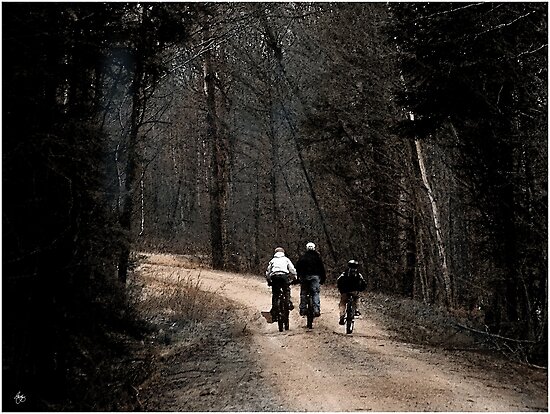
Deep in a Dorchester Woods


Links from this Podcast:
Podcast with Jack Savage
Free Joseph Website: http://www.freejoseph.net
Society for the Protection of New Hampshire Forests: https://forestsociety.org/


The Society for the Protection of NH Forests has pioneered conservation innovations since their founding in 1901.

Including A Podcast Conversation with Jack Savage, President SPNHF

I stood today on the summit of Welch Mountain and looked into the Sandwich Range accessed largely along the “Road Through Sandwich Notch” of which Elizabeth Yates wrote more than a century ago although she is best known for her book Amos Fortune- Free Man.

At one time the town of Sandwich, to which the Notch Road is now the backcountry gateway, was a provincial capital of New Hampshire. All along this road are the stone walls, cellar holes, and other signs of a day when the population of Sandwich was considerably larger.

The Notch Road into Sandwich is a beautiful backroad trip today, passing by Beede Falls, Cow Cave and Pulpit Rock where in the 1800s townsfolk would gather at the base of this huge Glacial Bounder and listen to the local preacher as he stood atop the rock delivering his sermon.

Sandwich Notch might have been developed over the years except for the good works of a number of local folks and the Society for the Protection of New Hampshire Forests.

Yet Sandwich Notch is only one of the Notches that the Society for the Protection of New Hampshire Forests has saved through the good works and generosity of thousands of members and friends. You may already know oftheir good works. but did you know that they led the way to making crowdfunding a “thing”?

Now it can be argued that "crowdfunding" is nothing new.

My Iroquois ancestors gathered together to help one another build their longhouses even before the Peacemaker and Hiawatha brought the Great Law to them more than 500 years ago. Early European settlers joined with one another to build barns or homes. However, there is no question that among the earliest efforts by nonprofit groups was the effort in the 1920s to save Franconia Notch through - among other things - the sale of "deeds" to a square foot of the Notch or the "purchase" of a tree, allowing thousands of people from across the nation to get involved with conservation efforts.

In just 120 years the Society has been at the forefront of change that has rippled out from the social and political boundaries of New Hampshire to the nation. Their founding effort to help pass the Weeks act not only resulted in the White Mountain National Forest but spread the National Forest fever across the continent.

There are very few organizations with which I share such a common kinship. So many of their efforts, focused on the lands and the people I am closest to, have become touchstones in my own life. The rallying point of their formation - the fight to save the forests of the White Mountains, and to protect the water resources, eventually led to adoption of the Weeks Act and the establishment of the National Forest in Congress. Their opposition to building a 4 lane super-highway through Franconia Notch resulted in the only scenic parkway of the Interstate highway system. The protection of Crawford Notch, Sandwich Notch, Lost River and the prevention of a ridgeline drive across the Presidential Range too were achieved with their leadership.

These epic battles were among the tales I would tell as I guided trail clearing, hiking and backpacking trips in the Whites in my early adult life. Even earlier they were the topics of dinner conversations around the family table at my home as a young boy.

Listening to my grandmother describe how she felt when she donated a hard-earned $10.00 to buy one square foot of tallis slope on the side of Cannon Mountain to protect Franconia Notch made me feel that I was part of a grand tradition here. I watched with admiration as my Mom and Dad helped lead the efforts to clean up the Pemigewasset River with other remarkable people like Pat & Tom Schlesinger of New Hampton, Syd and Olivia Howe, Dr. Larry Spencer at Plymouth State.

Later in my own home, around that same family table, my Senate office team would strategize ways to carry on that tradition: rebuilding the historic Smith Covered Bridge after it was burned by an arsonist, sponsoring the NH River's Protection Act, the Land Conservation and Investment Program, and conserving Livermore Falls.

The Forest Society served as inspiration for all of this, over the years developing a conservation ethic part John Muir - the preservationist - and part Gifford Pinchot - the architect of "wise use".

To some, it appeared that they were taking the safer, more moderate route to their destination. No one ever accused the Forest Society of being wild-eyed environmentalists; but to the great grandson of an Iroquois man and an Abenaki woman it seemed (and still seems) right . . . a part of the Circle; where people are neither beneath or above but an integral part of the whole.

When you venture out this summer - especially if you do so here in New Hampshire - say a quiet thanks to the generations of people who have helped to build the Society for the Protection of New Hampshire Forests. Because of them the White Mountain National Forest, Franconia Notch, Crawford Notch, Sandwich Notch and other sacred places of these white hills will forever be wild and free.


About Wayne D. King: Wayne King is an author, artist, activist and recovering politician. A three-term State Senator, 1994 Democratic nominee for Governor; he is the former publisher of Heart of New Hampshire Magazine and CEO of MOP Environmental Solutions Inc., and now a columnist for the New Hampshire Center for Public Interest Journalism (inDepthNH.org) where he writes “The View from Rattlesnake Ridge” and hosts two Podcasts: The Radical Centrist (www.theradicalcentrist.us) and NH Secrets, Legends and Lore (www.nhsecrets.blogspot.com). His art (www.waynedking.com) is exhibited nationally in galleries and he has published three books of his images and a novel "Sacred Trust" a vicarious, high voltage adventure to stop a private powerline - all available on Amazon.com. His art website is: www.waynedking.com , and his writing site: http://bit.ly/WayneDKing . He now lives in Thornton, New Hampshire at the base of Welch Mountain where he proudly flies both the American and Iroquois Flags.
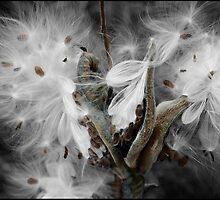


Milkweed Whisper


Society for the Protection of New Hampshire Forests

https://forestsociety.org/


Jack Savage is President of the Society for the Protection of New Hampshire Forests. He was appointed as the Forest Society’s fifth President in September 2019. Previously the Vice President of Communications/Outreach at the Forest Society for 14 years, he has been a key contributor to many of the Forest Society’s successes over the last decade. He has guided the organization’s evolving use of digital media to accomplish its land protection and advocacy goals, and overseen the expansion of its education and volunteer programs.

Savage’s family has roots in the forest products industry — they owned the Charleston Lumber Company in Charleston, W.V. in the 20th century. He and his wife, Cheryl, now make their home in a historic farmhouse in Middleton, NH, where they have lived with their dogs and horses since 1993.

As a writer and publisher, Savage has had broad experience in newspapers, magazines, and book publishing. He is a former editor of NH Profiles magazine, publisher of NH Seacoast Sunday newspaper, and operator of his own company, Carriage House Publishing. Savage is also a founding board member and past president of the New Hampshire Writers Project.

A certified Tree Farmer, Savage is active in his community, serving for the last 12 years as town moderator and formerly as selectman, chair of the Planning Board, and chair of the ZBA. As a volunteer and member of the regional conservation group Moose Mountains Regional Greenways, Savage helped facilitate the Forest Society’s conservation of more than 2,000 acres in the Moose Mountains range.

jsavage@forestsociety.org

Franconia Notch Documentary


Geology of Franconia Notch


Forest Society History

https://forestsociety.org/our-history
Protecting New Hampshire's landscapes since 1901
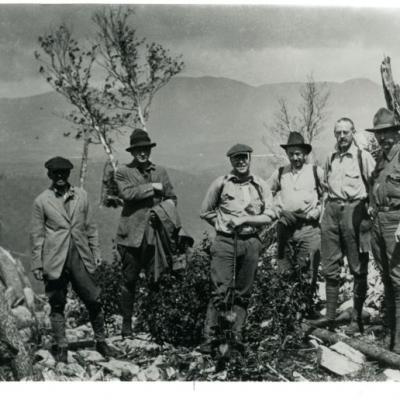


Forestry pioneers gathered on Mount Carrigain in 1919 to study five-year old slash. From left: Henry S. Graves, chief of the U.S. Forest Service and Society leader; J.J. Fritz, forest supervisor; Franklin Reed, district forester; Philip Ayres, Society forester; Allen Chamberlain, journalist and later to become president of the Appalachian Mountain Club; and C.B. Schiffer, district ranger. (Photo: USFS archives)

1901


Eight concerned citizens form the Society for the Protection of New Hampshire Forests. Their mission: to protect the White Mountains, which are rapidly being clear-cut.

1904


Mission Statement adopted: "The Society is a forestry association seeking to perpetuate the forests of New Hampshire through their wise use and their complete reservation in places of special scenic beauty."

1908


The Forest Society urges the state of New Hampshire to buy Crawford Notch. It does three years later.

1909


As a result of Forest Society urging, the state of New Hampshire appoints a state forester, and passes its first forest fire prevention laws.

1911


The Weeks Act is passed by Congress, after intense lobbying by the Forest Society and other conservation groups, leading to the establishment of the White Mountain National Forest.


The Forest Society buys 656 acres on Mount Sunapee to save it from being clear-cut.

1912


The Forest Society buys 148 acres around Lost River Gorge.

1915


The Forest Society acquires title to 600 acres on Mount Monadnock, beginning a process that ends up protecting more than 4,000 acres on the landmark mountain.

1918


The Forest Society begins work to acquire 1,500 acres on Mount Kearsarge.

1920


The Forest Society releases two breeding pairs of Minnesota beavers at Lost River. Prior to this, beaver had been extinct in New Hampshire for 30 years.

1923


The Forest Society leads a campaign to purchase 6,000 acres in Franconia Notch, including the Old Man of the Mountain, the Flume, the Basin, and two mountain lakes.

The Flume at Franconia Notch

1927


The Forest Society helps the state to buy Franconia Notch. The Forest Society retains ownership of 913 acres, including the Flume, and runs the park for 20 years until 1947.

1932


The Forest Society opens its first annual Nature Camp at Lost River. 90 years later, the Forest Society is still teaching people about the wonders of forests.

1934


The Forest Society helps defeat a proposal to build a "skyline drive" across the Presidential Range.

1937


The Forest Society begins publication of its magazine, Forest Notes, which is still published today.

1943


The Forest Society helps protect land surrounding Echo Lake and White Horse Ledge in North Conway.

1942


The state passes a constitutional amendment to end the annual taxation of growing timber — a victory the Forest Society had fought for since 1901.

1945


The Forest Society helps form the New England Forestry Foundation to promote better forest practices.

1948


The Forest Society transfers its 1,116 acres on Mount Sunapee to the state of New Hampshire.

1949


The Forest Society brings the Tree Farm program to the state, which encourages landowners to manage their woodlands for the long term.

1950


The Forest Society gives its final 520 acres on Mount Kearsarge to the state for the Frank Rollins Memorial Park, honoring the Forest Society's first president.

1959


The Forest Society opposes a super highway through Franconia Notch.

1960


Mr. & Mrs. Clarence L. Hay give the Forest Society 675 acres of woodland on Lake Sunapee.


Hay Reservation

1962


The Forest Society stops a plan to floodlight the Old Man of the Mountains.


Working with the Audubon Society of New Hampshire, and the state Fish & Game department, the Forest Society purchases land in the Hampton Salt Marshes to thwart a major development project.

1963


The Forest Society leads the way on legislation that creates town conservation commissions.

1966


Thirty-eight towns now have conservation commissions (by 2014 there will be 216 commissions).

1969


Plans for a nuclear power plant at Seabrook spur the Forest Society to lobby for extensive review of all major power installations.

1970


The federal government withdraws its plans for a tunnel and four-lane highway through Franconia Notch.


The Forest Society forms an interstate coalition to fight a proposed east-west superhighway across Vermont, New Hampshire and Maine.


The Forest Society opens an EcoCenter at Mount Monadnock to teach the 75,000 annual visitors about the mountain's ecology.

1971


The Forest Society negotiates its first conservation easement, which allows landowners to keep their land while preventing future development.

1972


The Forest Society begins a campaign to protect Sandwich Notch — the last unprotected notch in the state.

1973


After years of debate, the legislature enacts Current Use taxation, allowing millions of acres of land to remain as open space. A plan for a smaller parkway through Franconia Notch wins Forest Society support.

1974


The Forest Society purchases 726 acres on Gap Mountain. The next year, Mrs. Francis Fiske donates the south peak to the organization.


The Forest Society owns 7,189 acres in the state.


Gap Mountain

1976


The Forest Society celebrates the re-opening of the Monadnock-Sunapee Greenway, first laid out by Forest Society President Phil Ayres in 1925.

1978


Groundbreaking for the Forest Society's new headquarters begins. The award-winning Conservation Center gets over 80% of its heat from the sun and is an appropriate symbol of the organization's commitment to renewable resource use.

1982


The Forest Society works to get a bottle bill passed in the state, but it fails by one vote.

1983


The Forest Society helps raise awareness about the impacts of acid rain on New England's forests, laying the groundwork for important amendments to the Clean Air Act.

1984


The Wilderness Act passes the US Congress, designating 77,000 acres in the White Mountain National Forest as wilderness. Forest Society President Paul Bofinger chaired the committee that reached consensus on the bill.


The Forest Society owns 16,184 acres in the state.

1986


The Forest Society starts the Trust for New Hampshire Lands/Land Conservation Investment Program, a public-private six-year partnership that would protect more than 100,000 new acres in the state.

1987


A 10-year management plan is approved for the White Mountain National Forest. The Forest Society played a lead role in helping finalize the plan.

1989


The Forest Society, the state, The Nature Conservancy, and the U.S. Forest Service help save 40,000-acre Nash Stream forest in northern New Hampshire.

1990


The Forest Society serves on the Northern Forest Lands Council to find ways to sustain the four-state, 26-million acre forest and its people.

1993


The Forest Society creates the New Hampshire Conservation Institute to enhance and streamline its education and research efforts.


The Forest Society produces its award-winning Guide to Logging Aesthetics and a companion video to promote low-impact forestry without high impact costs.

1994


Forest Society reservations add up to 24,584 acres.

1995


The Forest Society creates its Living Landscape Agenda, a two-pronged plan to save special places and take care of land into the next century.

1997


The Forest Society acquires its 100th reservation - the High Watch Preserve in Effingham and Freedom.


High Watch Preserve. Photo Credit Jeff Sluder

1999


The Forest Society becomes the first private landowner in New Hampshire to have its land green-certified by SmartWood.

2001


The Forest Society celebrates its 100th anniversary — a century of outstanding accomplishments in the conservation and reservation of New Hampshire's forests.

2002


The Forest Society and the Museum of New Hampshire History launch a joint-project entitled Claiming the Land: Our Past, Our Future, Our Choice.


The New Hampshire House and Senate pass legislation regarding all-terrain vehicles (ATVs). The bill sets a policy for new ATV trails on state land and increases registration fees with revenue directed to enforcement, education, and trail acquisition. The Forest Society lent strong support to this bill.


The Forest Society, New Hampshire Public Television, and Cross Current Productions collaborate to produce Livable Landscapes: Chance or Choice , a one-hour documentary about citizens combating sprawl in their communities.

2003


The French Wing addition to the Forest Society's Conservation Center earns national recognition for innovation in "green building" design and construction. The U.S. Green Building Council awards its gold certification to the organization under the rigorous standards of the Leadership in Energy and Environmental Design program.


The Forest Society, federal and state officials, and other partner conservation organizations celebrate the permanent protection of 171,000 acres in northern New Hampshire.


The Connecticut Headwaters Project is the largest contiguous block of New Hampshire land in private ownership, comprising roughly three percent of the state.

2007


The Forest Society protects 3892 acres in fiscal year 2007, including 845 acres (10 projects) in forest reservations (land we own, 2,995 acres (27 projects) on which we hold conservation easements, and 52 acres (two projects) that we protected and will be transferred to a third party.


The Forest Society is also pleased to announce permanent LCHIP funding. The New Hampshire Land and Community Heritage Investment Program (LCHIP) is an independent state authority that makes grants to New Hampshire communities and non-profits to conserve and preserve New Hampshire’s most important natural, cultural and historic resources. Through this grant program every dollar invested brings in significant local, private, federal funds, and helps New Hampshire businesses and traditional business districts.

2013


The Forest Society is accredited by the Land Trust Alliance Accreditation Commission. The Commission, established in 2006 as an independent program of the Land Trust Alliance in Washington, DC, conducts an extensive review of each applicant’s policies and programs to determine if the applicant meets the national standards for excellence, upholds the public trust and ensures that conservation efforts are permanent.

2019


On February 13, 2019, a fire at The Rocks destroyed two historic buildings that we used for office space, programming, a gift shop and farm operations. In the wake of this devastating loss, the Forest Society had an opportunity to rethink the vision for this iconic North Country destination and launched a restoration project in 2020.


After nine years of hearings, meetings, and strategy sessions, the NH Supreme Court dealt a death blow to the Northern Pass project by ruling that the Site Evaluation Committee had indeed followed appropriate legal protocol in denying Northern Pass a certificate of site and facility. It was big win for New Hampshire’s landscapes, forests, and communities. Once again New Hampshire citizens stood their ground for the things they hold dear: open spaces unmarred by commercial development, downtowns with scenic charm, communities with a sense of who they are and what they want to be, farms that provide livelihoods for families, and the overwhelming sense that New Hampshire citizens, not some company from away, have the right—even an obligation—to determine their future.

2020


The Forest Society protected the Ammonoosuc River Forest in Bethlehem as its 191st forest reservation.
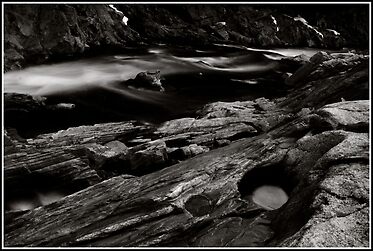


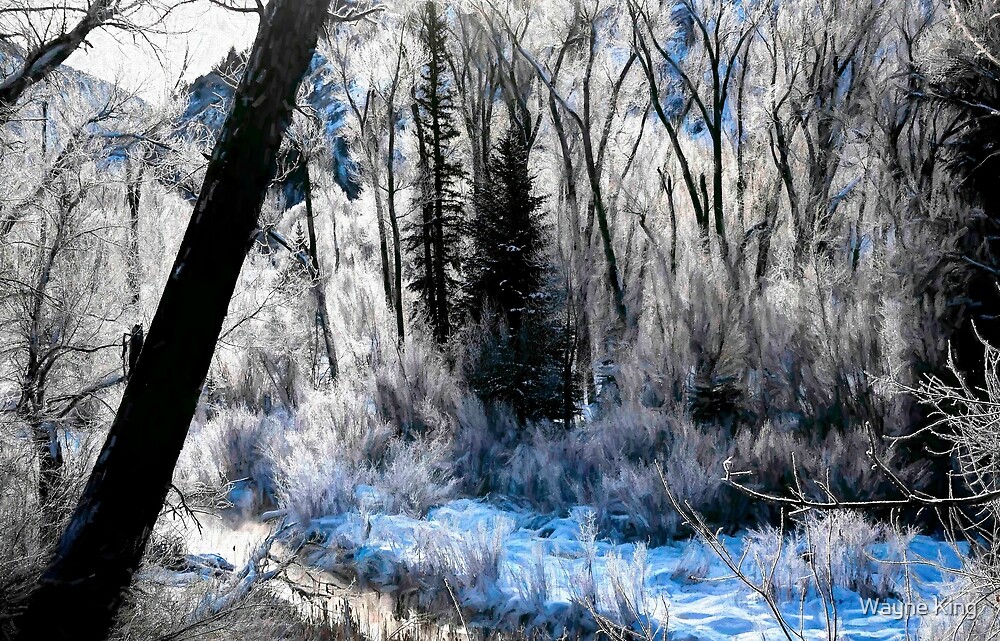
Peaholes on the Pemigewasset River


Glow on the Roaring Fork River


Saturday, April 24, 2021

Two Pandemics, One Cure - Truth & Justice

 The View from Rattlesnake Ridge


Flames Reaching for a Painted Sky


Two Pandemics, One Cure - Truth & Justice

Reconciliation Demands Truth and Justice as its Partner


My neighbor Bill appeared in his doorway this morning, as I was setting out on my ramble, with a smile on his lips. “Feels like Spring doesn’t it?” he quipped cheerily. Here we are just a few days from inauguration day and - if I didn’t know better - I would have thought that he was talking about that, not the spell of warm weather we are having here in the valley. But I know that Bill will not be cheering for Joe Biden and Kamala Harris as they stand before the nation to take the oath of office. He made sure to show me his Trump lawn sign on the day he brought it home last fall so it was not likely that he had undergone a conversion. 


I smiled and agreed with his assessment, content for the moment to revel in my own interpretation of his meaning but aware that what lay within the gaps - the unspoken reality - will be playing out across the nation in the coming days, months, years perhaps. 


Today our nation faces the test of two pandemics: one scientific and one moral, both posing existential threats to all that we hold dear. Both in need of the same cure - TRUTH. 


As of today, nearly 400,000 people have died, many unnecessarily, from the toxic brew of COVID-19 and the accompanying lies, incompetence and misdirection of an administration more interested in conjuring up conspiracies and redirecting blame than protecting our citizens. 


In addition to the firestorm of criticism and alarm over the storming of the Capital, there has been a growing effort by supporters of President Trump to attempt to redirect our attention with calls for healing and national reconciliation. For the most part, their argument has been that the President has been defeated and with that, is only days from leaving.  Our efforts and focus, they now contend, should be directed at moving on and bringing the country together. 


In other words, just ignore the fact that 93% of Republican members of Congress voted against impeachment in the face of overwhelming evidence that the President and his minions had actively incited insurrection; a direct attack on American Democracy.  For this reconciliation cannot come without a cost and that cost is truth. 


Furthermore, only one week before that - immediately after the attack on the capital - 8 Republican Senators and 66% of House Republicans refused to acknowledge and certify the election results, stubbornly sticking to the playbook of lies that have polluted social media and represent a long-term existential threat to the Republic. 


For months now I have been pulling at threads that weave a painful, long and winding path to today. One such thread even leads back to my beloved hometown and state and even to a younger version of myself. 


Until recently, I had come to believe the role that Attorney General Bill Barr has played in our descent into the shadows of American authoritarianism was an unprecedented threat to the Republic. After all, much of the covering fire for Donald Trump’s attack on the norms of democracy and the rule of law has been aided and abetted by AG Barr. 


However, as it turns out, Barr’s behavior had precedent in that of New Hampshire-born Nathan Clifford, a Democrat, who figured prominently into not one, but two of the greatest historic tragedies in American History: The Trail of Tears that stole the homelands and forced Native American communities from the Southeast onto lands in what is now Oklahoma;  and the destruction of post-Civil War Reconstruction and the birth of Jim Crow.


In 1832, over the opposition of American icons Daniel Webster, Davy Crockett, John Quincy Adams and Ralph Waldo Emerson, the United States Congress passed President Andrew Jackson’s Indian Removal Act. For six years the Cherokee nation valiantly tried to fight removal - peacefully - through the US Courts. In the end, they won only to have Jackson ignore the ruling of the United States Supreme Court, declaring “Mr. (Justice John) Marshall has made his ruling, now let him enforce it.” Ultimately, it was then-Attorney General Nathan Clifford who would rule - without justification - that the Indian removal was permissible. More than 25% of the men, women and children who began the Trail of Tears would not survive the journey, especially children and the elderly.


Nearly 40 years later, Clifford, by now a United States Supreme Court Associate Justice would be the deciding vote on the Tilden/Hayes Commission that decided what was at that time the closest election in US history in favor of Rutherford Hayes in a backroom political deal that ended Reconstruction and began what would come to be known as the Jim Crow era, condemning the United States to another 150 years of racial injustice. 


These betrayals of our American ideals have been papered over in the past 150 years, by generations of Americans, Including me when I sponsored what I thought to be an innocuous bill in the late 1980’s to name a rest area in honor of Clifford, an act I regret and renounce today.


This time, the betrayal of our Republic has been at the hands of the Republican Party. That betrayal has been profound and there can be no reconciliation without acknowledgment of the damage that the party has inflicted on the Republic. 


A strong two-party system is in the best interest of the American political system, but the Republican Party need not survive in order for that to be possible once again. In fact, without confronting the truth and purging those who have aided and abetted the Republican party’s descent into authoritarianism and white nationalism the party does not deserve to survive. The Republicans can just as easily go the way of the Whigs as long as another party - one actually dedicated to the American Republic emerges.  


But make no mistake neither party is without blame over the long arc of American history. The Democrats have plenty of shame and blood on their hands from the Trail of Tears to Jim Crow. 


America has arrived at a moment and only the cleansing of our national soul will help us to truly move beyond this together. 


Reconciliation is the balm to heal hearts but truth and justice must be the arrow that delivers it.  


Wayne King is an author, artist, activist and recovering politician. A three-term State Senator, he was the 1994 Democratic nominee for Governor and most recently the CEO of MOP Environmental Solutions Inc., a public company in the environmental cleanup space. His art  (WayneDKing.com) is exhibited nationally in galleries and he has published three books of his images with another, "New Hampshire - a Love Story", on the way. His most recent novel "Sacred Trust" a vicarious, high voltage adventure to stop a private powerline is available on Amazon.com. He lives in Thornton, between Rattlesnake Ridge and the Waterville Range. He proudly flies both the American and Iroquois Flags. His website is: http://bit.ly/WayneDKing


Monday, March 8, 2021

A Prophesy Wrapped in an Opportunity - Haaland Nomination Could be a Turning Point


Our Time Comes


A Prophesy Wrapped in an Opportunity

Haaland Nomination Could be a Turning Point


“Come dance with the west wind and touch on the mountain tops

Sail over the canyons and up to the stars

And reach for the heavens and hope for the future

And all that we can be and not what we are.”  ~ John Denver


March . . . the month that some native cultures refer to as the Sore Eyes Moon or the Squint Eye moon. You may have noticed that a mid-day walk on a sunny day requires sunglasses or squinting to avoid the glare that can actually bring tears to your eyes. 


Mornings feel different as well. 


With all the seasons I have lived here in the Northcountry I have become attuned to subtle cues that herald the changes of the seasons. In the coldest part of winter the sound symphony of morning includes the crows, jays, an occasional raven, following the booming basso profundo of the barred owls calling through the night, “who, who cooks - who cooks for you?” 


Then this week, still two weeks ahead of the vernal equinox with which we humans officially welcome spring, the sweet - and varied - melodies of the chickadees have joined the chorus. It’s as if they are excited children unable to constrain themselves in the face of evidence of the coming spring. Eager to lounge in the sun, run through the fields, jump in the puddles of a spring shower. 


Not that the tiny boreal banditos weren’t around all along, it’s just that they were less vocal, conserving themselves in virtual puffballs of feathers and air, marshaling their energy. Suddenly now, all that conserved energy is rushing to the surface. Even the red squirrels and the bluejays can’t help but alter their melodies and join in.  


These changes - the sudden symphony of hope - has its own parallels, in ways seen and unseen, across the landscapes of our lives. 


Today, as I wander in the midst of that symphony, my thoughts turn to my father, my grandfather, my great-grandfather. Three generations of Native Americans who lived their lives hidden from their Iroquois roots. Great grandfather who was, perhaps saved, but certainly wrested from his heritage by the orphanage that severed his tribal identity from those who would follow him. The mystery of whether he was Mohawk or Oneida or Seneca will likely never be revealed. But what we do know is that his ancestors birthed Democracy in this land. Midwived by the Peacemaker and Hiawatha and entrusted to the leadership of the strong and capable women of the Haudenosaunee people, the backbone of the Iroquois Confederacy. Yet, even though much is shrouded from their past, somehow I know that they too experienced the euphoria of this vernal moment, this symphony of hope and it ties me to them . . . gives me hope.


There is an oft-told prophecy among the Lakota (Sioux), who began their North American journey not far from the lands of the Haudenosaunee, in the Great Lakes Region, but migrated to the plains in the 1700s to become people of the horse. It is a prophecy about the White Buffalo Calf Woman, their most Sacred symbol who - in a time of terrible famine - brought to them their Sacred Pipe and Bundle that for 19 generations has been a talisman to the Lakota. Hundreds of years ago she told them that the White Buffalo would return as both a symbol of opportunity and a warning of crisis; A symbol of the opportunity for the unity of all humanity and the planet and a warning of the dangers ahead if we fail to adapt to the needs of the planet.  


The White Buffalo Calf Woman, and a host of other similar prophesies from other Indian nations tell of a great spiritual springtime that would emerge to unite the entire human family but it will be wrapped in a challenge to all humanity. For the Lakota, that time would be presaged by the appearance of a white buffalo calf. 


25 years ago the first documented white buffalo calf was born on a farm in Wisconsin and for almost 25 years now a white buffalo has walked on this earth. 


It would have been easy for Native American people to see this as an opportunity to parochially declare this as the season of their own rebirth. Through generations of pain and genocide, they would have the right to direct their focus inward.  But today their message embraces all of humanity and the need to heal the planet. As John Denver put it in his short but prophetic song “The Eagle and the Hawk” - to “reach for the heavens and hope for the future and all that we can be and not what we are.” 


The nomination of Congresswoman Debra Haaland, the first Native American woman to be nominated for a cabinet-level position - Secretary of the Interior - may be the next step in fulfilling the hopes of all those who long for a just and sustainable future. 


Haaland is a bridge-builder: Fearless and empathic, charitable and wise. All of the things we need to run one of the largest and far-reaching agencies in American government encompassing everything from our National Park system to grazing rights for farmers on public lands; from the Bureau of Indian Affairs to the US Geological Survey and the US Fish and Wildlife Service. She has, over the years, developed a reputation for reaching across the aisle, even during this most partisan of times, to create consensus between competing interests. Haaland’s confirmation would be a game-changer. Not because she would usher in radical change but because she would bring measured change with a vision and a future. 


Her nomination process has been, thankfully, without controversy regarding her heritage but the seeds of contention have largely been sown along the lines of those who see their primary role as protecting the interests of the fossil fuel industries in the face of ongoing pressure over climate change. Ironically, many of the companies - with the notable exception of ExxonMobil - that these elected officials believe themselves to be representing are already well on their way to embracing a new era of sustainable energy tied to a smart grid. Many of the big oil companies have begun the process of divesting of their fossil fuel dependence toward a greener, more sustainable energy economy. Secretary Haaland would be just the person to help them with the path along the way to this transition. In those rare cases where a company fails to see the future, I believe she would hold them to account, relying on the evidence of cooperation among the more thoughtful companies. 


The world is changing and those companies that fail to recognize and respond to the existential threat imposed by climate change are doomed to suffer the consequences. If for no other reason than the fact that 70% of young people under 35 feel that Global Climate Change is an existential threat to their future, any company that fails to see the sword of Damocles hovering above its head must have it buried in the tar sands.  


Representative Haaland has the rare opportunity to help lead this evolution. It will be a powerful economic force that will gain strength as the jobs of the future replace the fossil fools of the past. In her capable hands we will have a leader who understands that we may try to ignore the need to heal our planet, but we must never forget that the earth has the power to bring us into submission if we continue to ignore the natural laws that provide balance to life. 


Wayne King is an author, artist, activist and recovering politician. A three-term State Senator, he was the 1994 Democratic nominee for Governor and most recently the CEO of MOP Environmental Solutions Inc., a public company in the environmental cleanup space. His art (WayneDKing.com) is exhibited nationally in galleries and he has published three books of his images with another, "New Hampshire - a Love Story", on the way. His most recent novel "Sacred Trust" a vicarious, high voltage adventure to stop a private powerline is available on Amazon.com. He lives in Thornton, between Rattlesnake Ridge and the Waterville Range. He proudly flies both the American and Iroquois Flags. His website is: http://bit.ly/WayneDKing


Links to further reading and listening:


The White Buffalo Prophecy

https://www.youtube.com/watch?v=M8QrNBPqo3g


Chief Arvol Looking Horse Speaks of White Buffalo Prophecy

https://www.youtube.com/watch?v=PHqVdZmpRgI


2007 Sol Kanee Lecture - Chief Oren Lyons

https://www.youtube.com/watch?v=HiA4_e4YwZE

Chief Oren Lyons delivered the 5th Annual Sol Kanee Lecture "The Politics of Human Beings: The Nature of Global Warming", presented by the Arthur V. Mauro Centre for Peace and Justice at St. Paul's College.


Chief Arvol Looking Horse: Prophecies, World Peace, and Global Healing

https://www.youtube.com/watch?v=2J-iikPRtnw


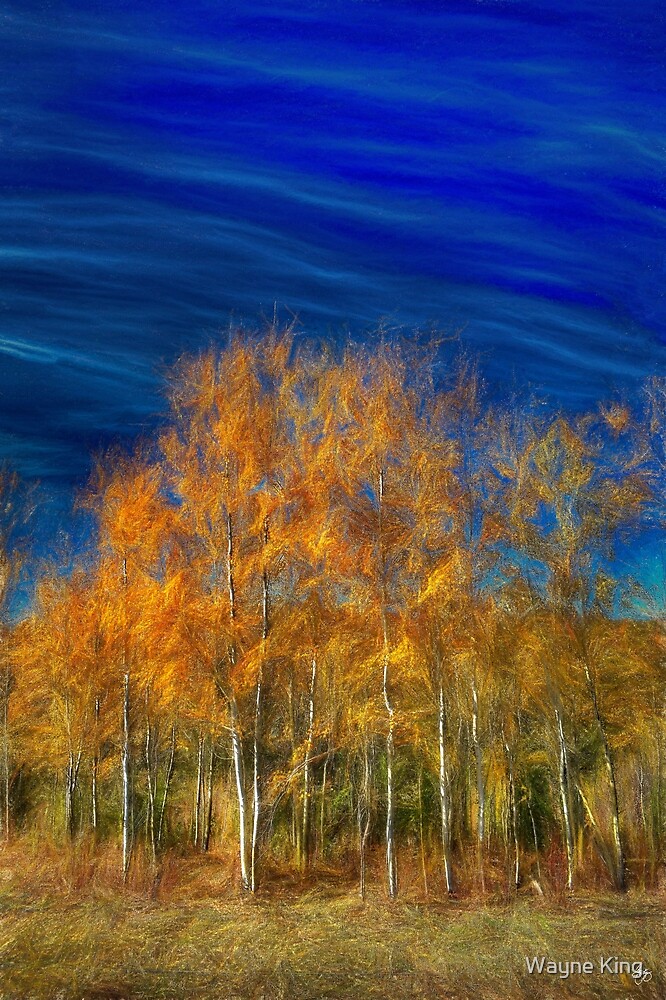
The Birch at Rattlesnake


Sunday, January 10, 2021

Reflections on American Democracy from West Africa


Reflections on American Democracy from West Africa

Two Decades, Two Elections, a World Apart


Today, on my daily hike, I walked into the past while reflecting on the recent attack on Democracy in our nation’s capital.


In 1997 I had the privilege of being asked by the Ford Foundation to put together a team of people to introduce the Internet to the Civil Society community in West Africa. Until we brought several thousand computers and training to the region even most students taking computer training classes had not laid hands on a keyboard. What flowed from that Ford grant was far more than just hardware, software and training for the NGOs in West Africa but also ten life-altering years for us. Years that gave us insights into the revolutionary possibilities of the net as well as the importance of the example that we in the USA set for the rest of the world.


Nigeria was particularly instructive in this process. In 1997 Nigeria was a study in authoritarian repression, under the thumb of a dictator named Sanny Abacha. The warnings of the US State Department were enough to scare off most of the people I invited to be on the team initially, but eventually, I was able to put together a team that included an extraordinary Nigerian-born American citizen, Dr. Chidi Nwachukwu, and a fearless friend from college Philip “Kip” Bates III who was a tech guru for the University of California in Santa Barbara. It was our task to help pro-democracy, healthcare, environmental and economic development organizations be more effective; to expand their reach through digital communication, providing computers, training and support for their efforts. Four other Nigerians, two men and two women played critical roles in the work we were to do. In the interest of their own safety right now I hesitate to name them for reasons that will become clear.  


The flight into Lagos, Nigeria aboard British Airways was to be the beginning of a surreal experience. Nothing on the trip to that point would hint at the experience that lay ahead. It was only when we deplaned into Lagos on a gangway that was completely dark, forcing us to feel our way into the terminal where only 1 in 4 lights were functional that we began to realize that we were, as Kip put it: “not in Kansas anymore.”  Almost nothing else that defines a well-run airport was working - people movers and escalators were motionless, arrival and departure boards void and unlit, 


Within 24 hours we were subject to numerous shakedowns by uniformed officers, saw a headless corpse along the freeway (“It takes a few days to pick those up” -  our driver remarked.). 

A few days later we were arrested on the streets of Lagos when our cabbie stopped to ask for directions. Only the most rudimentary maps existed of the city of 13 million and GPS was et to come.  My entire team was held at gunpoint by military and police officers, pointing semi-automatic rifles, for more than 6 hours - demanding to know what our “mission” was. Eventually, we were released. 


Years later, from the safety of home, we would speculate that we were arrested because we were helping pro-democracy NGOs, but it is just as likely that it was pure paranoia by police and military infected by the tentacles of authoritarianism.


I relate this beginning to a decade of work mostly because it gave us a glimpse into what happens when a government runs roughshod over its people and the rule of law is a far off dream to the millions of people living in the grip of authoritarian rule. 


Within a year of that first trip to West Africa Abacha had died - under mysterious circumstances - and Nigerian leadership had been taken over by General Abubakar, who replaced Abacha, but who was determined to return Nigeria to democratic rule. In 1999 the Nigerian people elected Olusegun Obasinga president of a Democratic Nigeria.  


Obasinga was far from perfect as a leader but a focus on ending official corruption began to lift the spirits of the Nigerian people and by the time we made a trip in November 2000 it was clear that Nigeria was moving in the right direction and hope was beginning to blossom. Suddenly, if a uniformed officer tried to shake us down for money all we had to do was ask them - very publicly - to speak up and they would immediately back off. 


The US election of 2000 occurred right in the middle of our trip. The recount in Florida, the hanging chads, the protests, the judicial decisions. In every moment of the drama I had a hoard of “students” eager to understand what was going on, full of questions, awestruck that an election this close did not result in soldiers and tanks in the streets. 


Despite my intense disappointment over the results and the final decision by the Supreme court, I watched Vice President Gore make what was the most wrenching speech of his life, a concession in spite of winning a majority of votes. It was heartbreaking and yet I have never been so proud of my country and our dedication to the rule of law and the democratic process. I shared that with all of the Nigerian people who watched and listened to me in rapt attention. They had a front-row seat not only to history but to the power of an idea. 


On Thursday the 7th of January 2021 I wept as I watched a few thousand people attack OUR capital in an attempt to overturn a valid election. My sadness was not only because all of those people, young and old, with whom I had stood in Nigeria some twenty years ago had watched that idea betrayed, but also because they are living with a president of their own who has taken a lead from our president to drag Nigeria into their own corrupt hell. 


For nearly ten years Nigeria was on a path toward a more perfect union and in the last 4 years everything they had gained has been lost. 


It’s quite likely that you never even knew this. Even in normal times Nigeria is not really on the radar of most Americans, though it has the potential to be the economic powerhouse of Africa. Over the past four years we have all been drinking daily from the firehose of Donald Trump’s narcissism, there has barely been any bandwidth for most of what has truly mattered.


While America has looked the other way President Muhammadu Buhari has looted his country and betrayed his people. 


Donald Trump has done more than just coddle the dictators and strongmen we know, he has done violence to the idea of Democracy all over the world and it is in the quiet recesses of human endeavor that he may have done the greatest violence of all.


Now it falls to us, we the people, to wrest our democracy back from the precipice and to send a message to tyrants near and far, including our own, that we may have lost sight of the dream briefly but we will not squander the lessons we have learned. It will not be easy, it will not be fast, and it will not be without sacrifice - but let us begin.


To my friends in Nigeria and in the hundreds of countries where men and women yearn for freedom, equality and opportunity, do not despair, the dream lives on.


Wayne King is an author, artist, activist and recovering politician. A three-term State Senator, he was the 1994 Democratic nominee for Governor and most recently the CEO of MOP Environmental Solutions Inc., a public company in the environmental cleanup space. His art  (WayneDKing.com) is exhibited nationally in galleries and he has published three books of his images with another, "New Hampshire - a Love Story", on the way. His most recent novel "Sacred Trust" a vicarious, high voltage adventure to stop a private powerline is available on Amazon.com. He lives in Thornton, between Rattlesnake Ridge and the Waterville Range. He proudly flies both the American and Iroquois Flags. His website is: http://bit.ly/WayneDKing


From "Screen Door" to "String Too Short to Keep"

  From "Screen Door" to "String Too Short to Keep"  A poetic journey across time and space in New Hampshire with Poet El...